Noah And The Flood

For Blog

This past Sunday Allen read from Matthew 24 during the confession time. The NIV text of Matthew 24:37-39 says:

“As it was in the days of Noah, so it will be at the coming of the Son of Man. 38 For in the days before the flood, people were eating and drinking, marrying and giving in marriage, up to the day Noah entered the ark; 39 and they knew nothing about what would happen until the flood came and took them all away. That is how it will be at the coming of the Son of Man.”

This text is a powerful reminder that Jesus will return and his return will be a complete and utter shock to many, just like the flood was a complete shock to many. Matthew Henry says: “What words can more strongly describe the suddenness of our Saviour’s coming! Men will be at their respective businesses, and suddenly the Lord of glory will appear. Women will be in their house employments, but in that moment every other work will be laid aside, and every heart will turn inward and say, It is the Lord! Am I prepared to meet him? Can I stand before him?” Charles Spurgeon adds: “That Jesus will come, is certain. That his coming may be at any moment, is equally sure; and, therefore, we ought to be always ready for his appearing.”

Mark read a powerful quotation from Francis Shaeffer commenting on Genesis 7:16 when God shut the door of the ark. This is what Francis Shaeffer said: “Genesis 7:16 is a striking verse: “And they that went in, went in male and female of all flesh, as God had commanded him: and the LORD shut him in.” This is a hard verse, and I am thankful that Noah did not have to shut the door. Knowing that men would soon be drowning all around him, I don’t see how Noah could have done it. But he wasn’t asked to. He was asked to be faithful—a preacher of righteousness. He  was asked to believe God and God’s propositional promise. He was asked to build a boat. But after he built the boat, the time came when God shut the door. That was the end of the time of salvation. It was closed because God had closed it at a point in the flow of history.” These words from Francis Shaeffer made me think about Matthew 24 and the return of Jesus. I powerfully felt in my soul that when Jesus returns that will mark the end of the time of salvation. Missionary martyr Jim Elliot wrote in his journals that: “Thoughts of Jesus’ coming flicker and make me tremble.” I tremble as well, and this Sunday at North Avenue as the words of Francis Shaeffer were read I thought of all the people in my life who don’t know Jesus. There are just so many who don’t know Jesus and the end of the time of salvation is coming. Jim Elliot who died trying to reach the unreached with the gospel wrote in his journals: “I know inside that the flesh would like more training—and perhaps I’m fitted to train more—everybody seems to be planning on it around here. But those generations passing away at this moment! They must hear of the Savior! How can we wait? O Lord of Harvest, do send forth laborers! Here am I, Lord. Behold me, send me. How deaf must be the deafness of the ear which has never heard the story; how blind the eye that has not looked on Christ for light; how pressed the soul that has no hope of glory; how hideous the fate of man who knoweth only night! God arouse us to care, to feel as He Himself does for their welfare.” Yes, Father arouse us to care, not only for the unreached but for the lost and unsaved that we rub shoulders with every day!

Walking With God

Mark actually started off his sermon recapping some previous chapters of Genesis. We were reminded how we can read the Bible in a way that doesn’t commune with God at all. For example we can go to the Bible and read it just to gain knowledge and not meet God in our Bible reading. This so often is my own problem. We can easily make an idol out of doctrine. We should be seeking to meet God in our Bible reading. So, we can read the Bible in wrong ways, but we can also avoid reading the Bible altogether. Why do we so often neglect Bible reading? Well, Adrian Rogers says that he has read lots of books, but the Bible is the only book that reads him. As Mark said as you read the Bible it talks to you. James tells us that the Word of God is a mirror. The Bible tells us what we ought to be, and we avoid reading it at times because we know how far short we are falling. We are afraid that we might actually meet God and He may confront us and our sins. The Word of God exposes us and we don’t want to be exposed. So, at times we leave our Bible’s on the shelf to gather dust because we don’t want to be exposed.

We looked at Genesis 5 and Enoch, who stands out in that chapter. Genesis 5:21-24 says:

“When Enoch had lived 65 years, he fathered Methuselah. 22 Enoch walked with God after he fathered Methuselah 300 years and had other sons and daughters. 23 Thus all the days of Enoch were 365 years. 24 Enoch walked with God, and he was not, for God took him.”

The New Testament tells us that Enoch and Elijah are the only two people in the Old Testament who avoid death. I just want to spend a little time talking about what it means to walk with God. The great evangelist George Whitefield (1714-1770) says: “Enoch walked with God; that is he kept up and maintained a holy, settled, habitual, though undoubtedly not altogether uninterrupted communion and fellowship with God, in and through Christ Jesus…walking with God consists especially in the fixed habitual bent of the will for God, in a habitual dependence upon his power and promise, in a habitual voluntary dedication of our all to his glory, in a habitual eyeing of his precept in all we do…”

Matthew Henry at the end of his life told a friend of his: “You have heard many men’s dying words, and these are mine: a life spent in communion with God is the pleasantest life in the world.” You may say, but doesn’t the Bible say in 2 Timothy that ‘all who desire to live a godly life in Christ Jesus will be persecuted? How can communion with God be the pleasantest life in the world then? George Whitefield says that it is true that the people of God are frequently afflicted, persecuted, and tormented. “But what of all this? Does this destroy the pleasure of walking with God? No, in no way; for those that walk with God are enabled, through Christ strengthening them, to joy even in tribulation, and to rejoice…I believe I may appeal to the experience of all true and close walkers with God, whether or not their suffering times have not frequently been their sweetest times, and that they enjoyed most of God when most cast out and despised by men?”

Communion With God Through Suffering

I could give hundreds and hundreds of examples of Christians who have enjoyed some of the sweetest times with God while suffering. I will share one from missionary John Paton. John Paton was an amazing man of God. John Piper gives a wonderful biographical sketch of him, that I would encourage you to listen to here.

John Paton went to the New Hebrides Islands which were filled with cannibals. Today these Islands are called the Vanuatu Islands. John Piper says: “To the best of our knowledge, the New Hebrides had no Christian influence before John Williams and James Harris from the London Missionary Society landed in 1839. Both of these missionaries were killed and eaten by cannibals on the island of Erromanga on November 20 of that year, only minutes after going ashore. Forty-eight years later John Paton wrote, “Thus were the New Hebrides baptized with the blood of martyrs; and Christ thereby told the whole Christian world that he claimed these islands as His own” John Paton feels the call of God to go to these same Islands. Many people from his home church protest and try to discourage him from going. One man in particular Mr. Dickson angrily confronts him and exploded: “The cannibals! You will be eaten by cannibals!” ‘The memory of Williams and Harris on Erromanga was only 19 years old. But to this Paton responded:’

“Mr. Dickson, you are advanced in years now, and your own prospect is soon to be laid in the grave, there to be eaten by worms; I confess to you, that if I can but live and die serving and honoring the Lord Jesus, it will make no difference to me whether I am eaten by Cannibals or by worms; and in the Great Day my Resurrection body will rise as fair as yours in the likeness of our risen Redeemer.”

You have to love John Paton! May it be true of all of us that we will all ‘live and die serving and honoring the Lord Jesus!’ So, John Paton and his wife go to the New Hebrides Islands in 1858. He deals with much suffering and persecution. Let me just share two of those stories from Paton. Here is one when his house was surrounded by the natives:

“when natives in large numbers were assembled at my house, a man furiously rushed on me with his axe but a Kaserumini Chief snatched a spade with which I had been working, and dexterously defended me from instant death. Life in such circumstances led me to cling very near to the Lord Jesus; I knew not, for one brief hour, when or how attack might be made; and yet, with my trembling hand clasped in the hand once nailed on Calvary, and now swaying the scepter of the universe, calmness and peace and resignation abode in my soul.”

So, in these life and death situations John Paton is walking with God. He is clinging close to the Lord Jesus. Mark said that walking with God means that we walk in repentance and faith. So, Paton takes his trembling hand of faith and clasped it in the hand once nailed on Calvary, and now swaying the scepter of the universe. Then ‘calmness and peace and resignation abode in his soul.’ Let us follow John Paton and walk with God in this way. The throne of grace is wide open, and sweet communion with the Lord Jesus will follow. As Paul says in Philippians 4: “do not be anxious about anything, but in everything by prayer and supplication with thanksgiving let your requests be made known to God. And the peace of God, which surpasses all understanding, will guard your hearts and your minds in Christ Jesus.”

The last story that I will share from John Paton I will let John Piper introduce: “One of the most powerful paragraphs in John Paton’s Autobiography describes his experience of hiding in a tree,…as hundreds of angry natives hunted him for his life. What he experienced there was the deepest source of Paton’s joy and courage.” Paton writes:

“I climbed into the tree and was left there alone in the bush. The hours I spent there live all before me as if it were but of yesterday. I heard the frequent discharging of muskets, and the yells of the Savages. Yet I sat there among the branches, as safe as in the arms of Jesus. Never, in all my sorrows, did my Lord draw nearer to me, and speak more soothingly in my soul, than when the moonlight flickered among those chestnut leaves, and the night air played on my throbbing brow, as I told all my heart to Jesus. Alone, yet not alone! If it be to glorify my God, I will not grudge to spend many nights alone in such a tree, to feel again my Savior’s spiritual presence, to enjoy His consoling fellowship. If thus thrown back upon your own soul, alone, all alone, in the midnight, in the bush, in the very embrace of death itself, have you a Friend that will not fail you then?”

So, Paton’s question is when we are in the very embrace of death itself do we have a Friend that will not fail us then? Well, for the first 23 years of my life I didn’t have this Friend. I was “dead in the trespasses and sins in which I once walked, following the course of this world, following the prince of the power of the air, the spirit that is now at work in the sons of disobedience— among whom we all once lived in the passions of our flesh, carrying out the desires of the body and the mind, and were by nature children of wrath, like the rest of mankind.” I was “separated from Christ, alienated from the commonwealth of Israel and a stranger to the covenant of promise, and I didn’t have any hope and was without God in the world.” I didn’t have this Friend that Paton speaks of. However, the door of God’s salvation didn’t close on me as it did in the days of Noah. God pursued me and now in Christ Jesus I who was once far off have been brought near by the blood of Christ. 

Jesus is the true and better Ark. He endured the flood of God’s wrath on the cross. “What a friend we have in Jesus, All our sins and griefs to bear!” Matthew Henry says: “Christ,…hath by his sufferings already prepared the ark, and kindly invites us by faith to enter in. While the day of his patience continues, let us hear and obey his voice.”




The Cross And The Empty Tomb

large_can-we-sing-too-much-about-the-cross

Last Sunday we celebrated Easter Sunday at North Avenue. Mark started off his Easter sermon from the unlikely text of Genesis 5. The first 11 verses of Genesis 5 are below:

“This is the book of the generations of Adam. When God created man, he made him in the likeness of God. Male and female he created them, and he blessed them and named them Man when they were created. When Adam had lived 130 years, he fathered a son in his own likeness, after his image, and named him Seth. The days of Adam after he fathered Seth were 800 years; and he had other sons and daughters. Thus all the days that Adam lived were 930 years,and he died. When Seth had lived 105 years, he fathered Enosh. Seth lived after he fathered Enosh 807 years and had other sons and daughters. Thus all the days of Seth were 912 years, and he died. When Enosh had lived 90 years, he fathered Kenan. 10 Enosh lived after he fathered Kenan 815 years and had other sons and daughters.11 Thus all the days of Enosh were 905 years, and he died.”

After each of these people are mentioned you find this same phrase: “and he died.” Death is not a respecter of persons. As Mark said the last time he checked 10 out of 10 people die. My Dad who has been a pastor for 34 years, preached an incredible sermon a few years ago, and he talked briefly about how he has seen a lot of people die. Meaning, he has seen a lot of people go through the dying process. I put a 10 minute clip together of this sermon from my Dad and would encourage you to give it a listen here. Tony Reinke writes: “Sinners run backward toward an open grave, said Martin Luther, unable to face death but inevitably moving straight at it, trying to put it out of sight and out of mind with any diversion, and yet shuffling in reverse until the inevitable meeting occurs. Then the sudden tumble down.” Reinke continues: “How many of us think of death in a given day? The reality is that very rarely do we think about death. We shuffle backwards to avoid the subject altogether.” Death is a somber reality. Martyn Lloyd-Jones said: “life is not a game; it is not a play; it is not just play-acting. Oh, life is serious and solemn; it is real and it is earnest.” Life is serious and solemn because death is coming. As Hebrews 9:27 tells us: “And just as it is appointed for man to die once, and after that comes judgment,…” So, death, then face to face with King Jesus, then either everlasting joy or everlasting pain. As John Piper says that this: “brief little life that you and I live and that everybody in our churches lives, will issue very quickly into everlasting joy or everlasting pain. This has got to grip us!”

Next Mark read from Thomas Jefferson’s version of the Bible. The TJV 🙂 Thomas Jefferson was a Deist. So, he didn’t believe in the miraculous or supernatural. His Bible is basically just the words of Jesus from the four gospels without any mention of anything miraculous or supernatural. His Bible ends with the body of Jesus being put into the tomb, and the stone is rolled over to cover the entrance of the tomb. Praise God that our Bible’s don’t end this way. If our Bible’s did end the way that Thomas Jefferson’s does, we would have no hope whatsoever. Our lives would have no ultimate purpose or significance. As Paul says in 1 Corinthians 15: “And if Christ has not been raised, your faith is futile and you are still in your sins. 18 Then those also who have fallen asleep in Christ have perished. 19 If in Christ we have hope in this life only, we are of all people most to be pitied.” How terrible it would be if Jesus had not been raised from the dead!

1 Corinthians 15

Next, Mark took us to 1 Corinthians 15 and we looked at the first couple of verses:

“Now I would remind you, brothers, of the gospel I preached to you, which you received, in which you stand, and by which you are being saved, if you hold fast to the word I preached to you—unless you believed in vain.”

Paul is reminding the Corinthian church once again of the gospel. We so often think that the gospel is only for non Christians. We think that once we become Christians we move on from the gospel to deeper theological truths. Jerry Bridges reminds us that we never outgrow the gospel. Tim Keller says: “We never “get beyond the gospel” in our Christian life to something more “advanced.” The gospel is not the first “step” in a “stairway” of truths, rather, it is more like the “hub” in a “wheel” of truth. The gospel is not just the A-B-C’s but the A-Z of Christianity. The gospel is not just the minimum required doctrine necessary to enter the kingdom, but the way we make progress in the kingdom.”

Jerry Bridges says: “The Gospel is not only the most important message in all of history; it is the only essential message in all of history. Yet we allow thousands of professing Christians to live their entire lives without clearly understanding it and experiencing the joy of living by it.” As Mark said this past Sunday we want North Avenue Church to be a gospel saturated church. We should be constantly talking about the glories of the gospel. We should be texting each other Bible passages filled with the gospel. Why do we need to be reminded of the gospel so often? One of the reasons is that we have the tendency to assume the gospel and then we forget the gospel. C.J. Mahaney says: “I want to meditate each day on Christ and him crucified. Each day I need to remind myself of the gospel. I cannot live on yesterdays recollection of the gospel. I need to review and rehearse the gospel each day or I will assume the gospel, forget the gospel, and prove vulnerable to all manner of temptation and sin.”

Let me go back to Jerry Bridges again who has been so helpful in my own life. He says: “We need to continue to hear the gospel every day of our Christian lives. Only a continuous reminder of the gospel of God’s grace through Christ will keep us from falling into good-day-bad-day thinking, wherein we think our daily relationship with God is based on how good we’ve been. It is only the joy of hearing the gospel and being reminded that our sins are forgiven in Christ that will keep the demands of discipleship from becoming drudgery.” He goes on: “The gospel, applied to our hearts every day, frees us to be brutally honest with ourselves and with God. The assurance of His total forgiveness of our sins through the blood of Christ means we don’t have to play defensive games anymore. We don’t have to rationalize and excuse our sins. We can say we told a lie instead of saying we exaggerated a bit. We can admit an unforgiving spirit instead of continuing to blame our parents for our emotional distress. We can call sin exactly what it is, regardless of how ugly and shameful it may be, because we know that Jesus bore that sin in His body on the cross.”

I will give an example from this morning how I was reminded of the gospel and how my heart and affections were stirred up. I am not a morning person by any means. I typically read my Bible first thing out of bed then take a quick shower, give my wife a kiss and drive about 10 minutes to work. I have been listening to Mark’s sermons the last several weeks during my 10 minute drives to and from work. So, this morning I jumped into 2nd Peter for a bit, then took my shower, kissed my wife, then jumped in the car and turned Mark’s sermon on which had about 18 minutes left in it. My heart was somewhat cold, I was feeling tired and somewhat sluggish. As I drove the familiar roads to work, Mark began to unpack the sufferings of Jesus. I am sitting at a traffic light with the sun rising off in the distance. Simultaneously, the sun of the gospel was rising from Mark and I found my heart and affections being stirred. Tears filled my eyes and rolled down my cheek as I was once again stunned by the love of Jesus and the depth of my sin. We need the gospel every day. We need to continually rediscover the gospel each day as Tim Keller says. As John Stott says: “The Cross is the blazing fire at which the flame of our love is kindled, but we have to get near enough for its sparks to fall on us.” So, let’s run near to the Cross of Jesus each day and have our love freshly kindled.

Paul continues in 1 Corinthians 15:3&4:

“For I delivered to you as of first importance what I also received: that Christ died for our sins in accordance with the Scriptures, that he was buried, that he was raised on the third day in accordance with the Scriptures,”

C.J. Mahaney starts out his fantastic little book like this:

“Each of our lives is centered on something. What’s at the center of yours? Think about it for a moment. What’s really the main thing in your life? Only one thing can truly be first in priority; so what’s at the top of your list, second to none? Or let me put it this way: What are you most passionate about? What do you love to talk about? What do you think about most when your mind is free? Or try this: What is it that defines you? Is it your career? A relationship? Maybe it’s your family, or your ministry. It could be some cause or movement, or some political affiliation. Or perhaps your main thing is a hobby or a talent you have, or even your house and possessions. It could be any number of good things—but when it comes to centering our life, what really qualifies as the one thing God says should be the most important?…”

“Here’s how Paul answers that question: “Now I would remind you, brothers, of the gospel I preached to you….For I delivered to you as of first importance what I also received: that Christ died for our sins.” First importance. Paul is pointing us to the one transcendent truth that should define our lives. In the midst of our various responsibilities and many possible areas of service in the kingdom of God, one overarching truth should motivate all our work and affect every part of who we are: Christ died for our sins.” May this be true in all of our lives, that the one overarching truth that would motivate all our work and affect every part of who we are would be that Christ died for our sins.

Paul ends 1 Corinthians 15 with these powerful verses (50-58):

“I tell you this, brothers: flesh and blood cannot inherit the kingdom of God, nor does the perishable inherit the imperishable. 51 Behold! I tell you a mystery. We shall not all sleep, but we shall all be changed,52 in a moment, in the twinkling of an eye, at the last trumpet. For the trumpet will sound, and the dead will be raised imperishable, and we shall be changed. 53 For this perishable body must put on the imperishable, and this mortal body must put on immortality. 54 When the perishable puts on the imperishable, and the mortal puts on immortality, then shall come to pass the saying that is written:

“Death is swallowed up in victory.”
55 “O death, where is your victory?
    O death, where is your sting?”

56 The sting of death is sin, and the power of sin is the law. 57 But thanks be to God, who gives us the victory through our Lord Jesus Christ.

58 Therefore, my beloved brothers, be steadfast, immovable, always abounding in the work of the Lord, knowing that in the Lord your labor is not in vain.”

So often we in the church tend to view verses like these as a fairy tale. We don’t actually believe deeply within our souls that this is going to happen. However, we are one day closer to the last trumpet sounding! Matthew Harmon says: “Jesus’s resurrection ensures us that we too will one day have resurrection bodies. Now, what those resurrection bodies are like is something of a mystery. In 1 Corinthians 15:35–49 it tells us that there will be some continuity and some discontinuity between our current bodies and those resurrection bodies. But Philippians 3:20–21 tells us that when Christ returns, he will transform our bodies to match his glorious resurrection body. And that is a remarkable promise as well — living in a fallen world where our bodies decay and are subject to sickness and to aging — that there is coming a day when, because of Jesus’s resurrection, our bodies will be transformed to match his perfect, glorious resurrection body.” Matt Chandler powerfully writes: “Is it a stretch to think that we should live for that day? When history as the world knows it no longer exists, and there are no longer any great kings or great wars or great political machinations; when there are no histories of countries left to cherish, no more dollars; when it’s no longer the strong versus the weak, and all that’s left is the story of the great God and King, and all has been righted, and the heroes are now the missionaries and the ministers of grace—of which every believer can be—and our eyes behold Him as He truly is…words fail. That is where our heart ought to be…Let us wait for that day, expectantly and eagerly. Let us fix our eyes on heaven, where our citizenship is held securely, where we are presently united to Christ in spirit.”

The Sufferings Of Jesus

Mark ended his sermon very powerfully last Sunday describing in detail the sufferings of our Savior. I can’t improve on what he said here. I would just encourage you to listen to the entire sermon again, but if you can’t do that I would strongly encourage you to listen to the last 15 minutes. You can listen to the sermon here.

Picture from here


Crouching Sin & Crying Blood

crouching_lion

This past Sunday Mark spent the first several minutes discussing how we are figuratively covering ourselves in fig leaves. We want to cover our flaws and we don’t want to draw attention to them. We use social media to build our resumes. He powerfully reminded us that we are entertaining ourselves to death. We are almost afraid of being alone in silence, so we have constant distractions from iPhones, to iPads, to iPods, to movies, television and sports. We numb ourselves and distract ourselves with these things. Several years ago I listened to a series of sermons by John Piper on Romans chapter 2 and I went back and was reading through one of those and was convicted by these words from Pastor John Piper:

“I feel such a burden for us as a church to swim against the tide of almost every current in our culture. More and more and more, America is a nation given over to play. The industries of play are huge! Houses are built today with entertainment centers. Computers and videos and television and stereo all coordinate to give us ever more stimulating and captivating distractions from the realities of the world. When we need to be dreaming, for the glory of Christ, about how to spend our lives alleviating ignorance and sickness and misery and lostness, we are becoming more and more addicted to amusement.

Make a little test of evangelical vocabulary, and calculate, for example, the increasing frequency with which we use the world “fun” to describe almost everything we like. But when do we describe our good experiences as “meaningful” or “significant” or “enriching” or “ennobling” or “worthwhile” or “edifying” or “helpful” or “strengthening” or “encouraging” or “deepening” or “transforming” or “valuable” or “eye-opening” or “God-exalting”?

Examine yourself with this text (Romans 2): Whatever else it teaches, this is clear, it teaches that after death there is eternal life and glory and honor and peace, and there is eternal wrath and indignation and tribulation and distress. And in the twinkling of an eye, even before this service is over, you could be irreversibly in the one or the other. I am a watchman on the wall. And I have warned you as clearly as I know how. Get ready and stay ready.

Live in the light of eternity. And I do mean light, not shadow. When you have come to know your God, and love his Son so much that you can say, “For me, to live is Christ and to die is gain,” then living in the light of eternity will replace your “fun” with deeper, higher, wider, longer, more unshakable, more varied, more satisfying, more durable, more solid pleasures than all the fun that entertainment could ever give. O come, and let us be a different breed of people for the few short years we have to live upon this earth! Dream some dream of making your life count for Christ and his Kingdom. “Only one life, ’twill soon be past. Only what’s done for Christ will last.”

Enmity Between You And The Woman

We spent some time discussing Genesis 3:15 before getting to Genesis 4. Genesis 3:15 says:

“I will put enmity between you and the woman,
and between your offspring and her offspring;
he shall bruise your head,
and you shall bruise his heel.”

So, there is going to be enmity and friction between the seed of the serpent and the seed of the woman. What does this mean? In John chapter 8 Jesus is talking to the Pharisee’s and this conversation helps us to answer what this text in Genesis means. John 8: 41-44 says:

“You are doing the works your father did.” They said to him, “We were not born of sexual immorality. We have one Father—even God.” 42 Jesus said to them, “If God were your Father, you would love me, for I came from God and I am here. I came not of my own accord, but he sent me.43 Why do you not understand what I say? It is because you cannot bear to hear my word. 44 You are of your father the devil, and your will is to do your father’s desires. He was a murderer from the beginning, and does not stand in the truth, because there is no truth in him.When he lies, he speaks out of his own character, for he is a liar and the father of lies.”

Mark told us that to be a son or daughter of means to reflect the character traits and habits of your father. In Matthew 5:43-45 Jesus says: “You have heard that it was said, ‘You shall love your neighbor and hate your enemy.’ 44 But I say to you, Love your enemies and pray for those who persecute you, 45 so that you may be sons of your Father who is in heaven. For he makes his sun rise on the evil and on the good, and sends rain on the just and on the unjust.”

Jesus says: “Love your enemies and pray for those who persecute you, so that you may be sons of your Father who is in heaven.” John Piper helps us understand this passage when he says: “That is, show you are a child of God by acting the way your Father acts. If you are his, then his character is in you, and you will be inclined to do what he does. God loves his enemies—the evil and the unrighteous—in sending rain and sunshine on them instead of instant judgment.” He later says: “Jesus does not mean that loving our enemies earns us the right to be a child of God. You can’t earn the status of a child. You can be born into it. You can be adopted into it. You can’t work your way into it. Jesus means that loving our enemies shows that God has already become our Father, and that the only reason we are able to love our enemies is because he loves us and has met our needs first.”

What Genesis 3:15 is telling us is that for the rest of human history there is going to be conflict between the seed of the woman and the seed of Satan. So, the conflict and enmity will be between the people who reflect the character of Satan and those who reflect the character of the seed of the woman, who ultimately is Jesus. There will be friction between these two groups. We don’t have to wait very long before we see an example of this friction and enmity. Genesis 4 gives us an example of this.

Crouching Sin

The first seven verses of Genesis 4 are as follows:

“Now Adam knew Eve his wife, and she conceived and bore Cain, saying, “I have gotten a man with the help of the Lord.” And again, she bore his brother Abel. Now Abel was a keeper of sheep, and Cain a worker of the ground. In the course of time Cain brought to the Lord an offering of the fruit of the ground, and Abel also brought of the firstborn of his flock and of their fat portions. And the Lord had regard for Abel and his offering, but for Cain and his offering he had no regard. So Cain was very angry, and his face fell. The Lord said to Cain, “Why are you angry, and why has your face fallen? If you do well, will you not be accepted? And if you do not do well, sin is crouching at the door. Its desire is for you, but you must rule over it.”

Mark told us that we should put our name’s here in place of Cain’s because sin is crouching at all of our doors. Tim Keller is helpful here on the crouching nature of sin. Keller says: “It’s a remarkable image. It’s the image of a leopard or a tiger, a predatory animal, crouching in the shadows, coiled and ready to spring and kill.

God says that’s sin. Sin is predatory. Sin has a deadly life of its own. How is that? Here right away we’re going to see why there is no other set of vocabulary words that we have that deal with the reality of what sin is. How so? First of all, when God uses this image, it’s telling us that sin has an abiding, growing presence in your life. If you commit sin, sin is not over. Sin is not simply an action. It’s a force. It’s a power.

When you do sin, it’s not now over, but it actually becomes a presence in your life. It takes shape, a shadow shape, and stays with you and begins to affect you. Eventually, it can just take you out. You say, “Well, how could that be?” Well, you can start with the psychological concept of habit. You can start there, but you can’t end there. You can start by noticing the things we do become easier to do again and easier to do again and easier to do again and harder to stop doing…Here’s the point. When you sin, the sin doesn’t just go away. The sin becomes a presence in your life. You start by doing sin, but then sin does you.

You can decide, “I’m not going to forgive my mother, I’m not going to forgive my father, for what he or she has done.” Okay, you’ve done it, but then it will do you, because that will poison your relationships with other people, certain people in all kinds of ways you don’t even see. It will harden you.”

I have to keep quoting Keller here because this is good stuff:

“When you sin, that sin becomes a presence in your life. It takes shape in and around you, and it will take you out. Therefore, you should avoid sin like the plague, because it is a plague. Somebody says to you, “You know, you have a cancerous tumor growing in this part of your body.” You say, “Well, one of these years I’ll get to it.” You don’t do that. For somebody to come along and say, “You have an abrasive spirit,” or, “You can’t control yourself in this area,” or, “You have this,” or, “You have that character flaw,” you don’t say, “Well, yeah.”

Don’t you dare, because that’s the second aspect of potency we see in this image. The idea of sin crouching at the door not only tells us it’s coiled to spring (it’s a presence in your life that when you sin, you create a presence in your life that then can take you out), but also the image gets across the fact that sin hides.

See, the lion, the tiger, the leopard is crouching. That means down away out of your sight. Why? Because if you see a crouching tiger, you have a chance. You can get a couple of steps on it, but if you don’t see a crouching tiger, you’re dead. If you don’t see it well or you don’t know quite where it’s located … The less aware you are of the location or the reality of the crouching animal, the more vulnerable you are, and the more likely you are to die.

What that means is the worst things in your life, the character flaws and the sins in your life that are most going to ruin you or are ruining you or are going to make the people around you miserable are the things, the character flaws, you least will admit. They’re the ones you’re in denial about, you rationalize, and you minimize. Whatever the consequences happen to you, when somebody brings them up, you rationalize them.

By definition, those are the crouching sins in your life (the ones that are going to take you out). As long as you look at workaholism as conscientiousness, as long as you look at your grudge as moral outrage, as long as you look at materialism as ambition or arrogance as healthy self-assertion, as long as you look at your obsession with looks as good grooming, you’re vulnerable. You’re in denial.

Do you know what your sins are? Do you know what your besetting sins are? Do you know what your crouching sins are? If you don’t even have a list, then you’ve been mastered. So see the potency of sin. See how deadly it is. See why it’s nothing to take lightly. It’s nothing to be trifled with.”

Respectable Sins 

As Mark said this past Sunday that we in the church have the tendency to point our fingers at people outside the church and say they are the real sinners and they commit truly heinous sin. Whereas, we in the church don’t really struggle with sin. Jerry Bridges wrote a fantastic book called Respectable Sins. In this book he says: “Sin is sin. Even those sins that I call “the acceptable sins of the saints”―those sins that we tolerate in our lives―are serious in God’s eyes. Our religious pride, our critical attitudes, our unkind speech about others, our impatience and anger, even our anxiety (see Philippians 4:6); all of these are serious in the sight of God.”

He goes on: “the fact still remains that the seemingly minor sins we tolerate in our lives do indeed deserve the curse of God. Yes, the whole idea of sin may have disappeared from our culture. It may have been softened in many of our churches so as not to make the audiences uncomfortable. And, sad to say, the concept of sin among many conservative Christians has been essentially redefined to cover only the obviously gross sins of our society. The result, then, is that for many morally upright believers, the awareness of personal sin has effectively disappeared from their consciences. But it has not disappeared from the sight of God…the point is, all of our sin, wherever we may be on the spectrum of personal awareness of it in our lives, is reprehensible in the sight of God and deserving of His judgment.” He gives us two examples of the acceptable sins of the saints when he says: “So when I gossip, I am rebelling against God. When I harbor resentful thoughts toward someone instead of forgiving him or her in my heart, I am rebelling against God.”

Re-listening to Mark’s sermon and reading through what Jerry Bridges wrote and what Tim Keller said, I am once again convicted of my own sin, and I am once again reminded that I don’t want to be cavalier towards my own sin. I don’t want to entertain myself to death. I want to be like John Piper and hate all sin especially my own sin. I want to put to death the sins in my life like the Apostle Paul says: “Put to death therefore what is earthly in you: sexual immorality, impurity, passion, evil desire, and covetousness, which is idolatry.” I want to encourage others and I hope we as a church will excel at what Hebrews 3:13 calls us to do: “But encourage one another daily, as long as it is called “Today,” so that none of you may be hardened by sin’s deceitfulness.”

Crying Blood

Genesis 4:8-16 tell us:

“Cain spoke to Abel his brother. And when they were in the field, Cain rose up against his brother Abel and killed him. Then the Lord said to Cain, “Where is Abel your brother?” He said, “I do not know; am I my brother’s keeper?” 10 And the Lord said, “What have you done? The voice of your brother’s blood is crying to me from the ground.11 And now you are cursed from the ground, which has opened its mouth to receive your brother’s blood from your hand. 12 When you work the ground, it shall no longer yield to you its strength. You shall be a fugitive and a wanderer on the earth.” 13 Cain said to the Lord, “My punishment is greater than I can bear. 14 Behold, you have driven me today away from the ground, and from your face I shall be hidden. I shall be a fugitive and a wanderer on the earth, and whoever finds me will kill me.” 15 Then the Lord said to him, “Not so! If anyone kills Cain, vengeance shall be taken on him sevenfold.” And the Lord put a mark on Cain, lest any who found him should attack him. 16 Then Cain went away from the presence of the Lord and settled in the land of Nod, east of Eden.”

This is a prime example of the enmity and friction that is going on between Cain the seed of the serpent and Abel the seed of the woman. We spent a lot of time looking at the blood of Abel, and the fact that his blood cry’s out to God. Charles Spurgeon tells us what this blood spoke to God:

“Now what did Abel’s blood say to God? Standing by the place where Abel fell, and marking the ground all crimson with clotted gore, what would the blood seem to you to say? What would you conceive that the blood said to God? It said just this, “God, your creature has been destroyed without cause. No just reason of provocation has been given, no offence has been committed which could deserve so terrible a stroke; but one of your feeble creatures who has a claim upon your kind protection has been needlessly slain: his blood appeals to you! The first thing the blood said was, “I am an innocent victim won’t you do something? I’m made in your image, and you have promised to protect that which is made in your image and I have been needlessly and unjustly slain. Won’t you here?”

Yet the blood of Abel said more than this; it said, “Oh God, the blood shed here was shed for you.” “If it were not for love for you this blood would not have been shed! If these drops had not been consecrated by devotion, if this blood had not flowed in the veins of this man who loved God it would not have been poured out upon the ground. Oh God,” cries every drop, “I fell upon the ground for you—will you endure this? What force there is in such a voice!”

“…for the stroke which came from Cain’s hand was not aimed merely at Abel, it was in spirit aimed at God, for if Cain could have done the same to God as he did to his brother, Abel, he doubtlessly would have done it. Cain defies you. He has struck the first blow at yourself,… Will you look on in quiet? Will you take no vengeance? Oh God, will you not interpose?” Surely this is a heaven piercing cry,”

God then does respond in judgement as he curses the ground on which Cain walks. We all deserve the judgement of God to fall on us. We all deserve the wrath of God. We need to understand the weight of our sin and what it deserves. Our sin ultimately and primarily is against God Almighty! He is the most offended party when we sin.

The last passage that we looked at was found in Hebrews 12 which says we: “have come…to Jesus the mediator of a new covenant, and to the sprinkled blood that speaks a better word than the blood of Abel.”

So, the blood of Abel spoke to God, but the blood of Jesus also speaks to God and it speaks a far better word than the blood of Abel. Here is Charles Spurgeon once again on this blood:

“Can you stand at Calvary now and view the flowing of the Saviour’s blood from hands, and feet, and side? What are your own reflections concerning what that blood says to God? Think now at the foot of the cross. That blood cries with a loud voice to God, and what does it say? Does it not say this? “Oh God, this time it is not merely a creature which bleeds, but though the body that hangs upon the cross is…your own Son who now pours out his soul to death.

Observe that the blood of Abel spoke to God long before Cain spoke. Cain was deaf to the voice of his brother’s blood, but God heard it. Sinner, long before you hear the blood of Jesus, God hears it, and spares your guilty soul. Long before that blood comes into your soul to melt you to repentance, it pleads for you with God. It was not the voice of Cain that brought down vengeance, but the voice of Abel’s blood; and it is not the cry of the sinner seeking mercy that is the cause of mercy, it is the cry of that blood of Jesus. The blood does not need your voice to increase its power with God; he will hear your voice, but it is because he hears the blood of Jesus first of all. It is a mercy for us that…Jesus’ blood does not plead for the innocent, if such there are,…Jesus’ blood pleads for the rebellious that the Lord God may dwell among them; for you who have broken his laws, and despised his love, and fought against his power; the blood of Jesus pleads for such as you, for he came into the world to save sinners. “The Son of Man is come to seek and to save those who were lost.”

I know your sins speak very loudly—ah! well they may; I hope you will hear their voice and hate them in the future—but they cannot speak as loudly as the blood of Jesus does.”

God said to Cain, “What have you done?” Now that is what Christ’s blood says to you: “What have you done?” My dear hearer, do you not know that your sins killed the Saviour? If we have been playing with sin, and imagined it to be a very little thing, a trifle to play with and laugh at, let us correct the mistake. Our Saviour hangs on the cross, and was nailed there by those sins of ours; shall we think little of them?…Let me speak personally to everyone. Make an inventory now of your sins. Go over the black list from your childhood until now. What have you done? Ah! Lord, I have done enough to make me weep for ever if it were not that you have wept for me. Drops of grief can never repay the debt which is due to your blood. Alas! I have done evil, Lord, but you have been good to me. “What have you done? What have you done?” was a dreadful accusation to Cain, it might have gone through him like a dart; but to you and to me it is the soft enquiring voice of a Father’s love bringing us to repentance. May it bring us now!

I ask you, dear Christian friends, to come nearer to the blood of Jesus this morning…Think over the great truth of substitution. Portray to yourselves the sufferings of the Saviour. Dwell in his sight, sit at the foot of Calvary, abide in the presence of his cross, and never turn away from that great spectacle of mercy and of misery. Come to it; do not be afraid…you sinner, who have never trusted Jesus, look here and live! May you come to him now!

Indeed, do not run away from the wounds which you have made, but find shelter in them; do not forget the sufferings of Christ, but rest in them! Your only hope lies in trusting in Jesus, resting wholly upon him.”

Picture from here


Genesis 3: The Fall Followed By A Promise

73edae9484f410f3bf49358246e90fa5

At the end of Genesis 1 it says: “God saw everything that he had made, and behold, it was very good.” As John Piper says: “God did not create anything evil. It was all very good.” Then chapter 3 of Genesis starts and we find this serpent who is calling God’s word into question. This serpent is clearly evil. So, who is this serpent and how did he fall? Revelation 12:9 tells us that: “The great dragon was thrown down, that ancient serpent, who is called the devil and Satan, the deceiver of the whole world—he was thrown down to the earth, and his angels were thrown down with him.” So, clearly the ‘ancient serpent’ referenced here is the serpent in Genesis 3. So, this is the devil in Genesis 3. Ezekiel 28 tells us a little bit more about Satan before he fell:

“You were the signet of perfection, full of wisdom and perfect in beauty. 13 You were in Eden, the garden of God; every precious stone was your covering, sardius, topaz, and diamond, beryl, onyx, and jasper, sapphire, emerald, and carbuncle; and crafted in gold were your settings and your engravings. On the day that you were created they were prepared. 14 You were an anointed guardian cherub. I placed you; you were on the holy mountain of God; in the midst of the stones of fire you walked. 15 You were blameless in your ways from the day you were created, till unrighteousness was found in you. 16 In the abundance of your trade you were filled with violence in your midst, and you sinned; so I cast you as a profane thing from the mountain of God, and I destroyed you, O guardian cherub, from the midst of the stones of fire. 17 Your heart was proud because of your beauty; you corrupted your wisdom for the sake of your splendor. I cast you to the ground;”

So, Satan was a high ranking angel. He was a ‘guardian cherub.’ What was his sin? Verse 17 tells us that the first sin, was the sin of pride: “Your heart was proud because of your beauty;” God created millions and millions of angels. Perhaps billions. Satan sins against God and he takes 1/3 of the angels with him. As Revelation 12 says: “Now the dragon’s tail swept away a third of the stars in heaven and hurled them to the earth.”

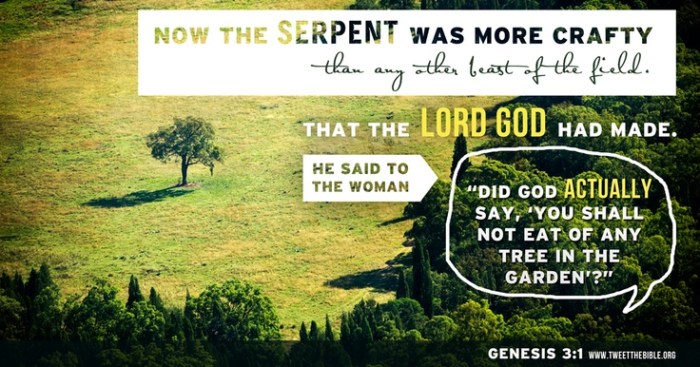
We come then to Genesis 3 which starts out saying: “Now the serpent was more crafty than any other beast of the field that the Lord God had made. He said to the woman, “Did God actually say, ‘You shall not eat of any tree in the garden’?” The word that the ESV translates as crafty is often translated with the word prudent or wise. So, the devil is very wise, but wisdom alone does not guarantee positive results. Many people today think that a lack of education is what is wrong with the world. If we could just get everyone educated we would not have the problems that we do now. However as Ravi Zacharias says: “If a man is stealing nuts and bolts from a railway track, and, in order to change him, you send him to college, at the end of his education, he will steal the whole railway track.” 

Mark said that pain and suffering as well as wealth and power only ever magnify who we really are. Satan’s wisdom and power magnify the evil within him. The same is true for the man stealing the nuts and bolts then he gains wisdom and steals the whole track. The evil in this man is magnified. I thought I would include a more positive example of this. In this example pain and suffering magnify true Christian character. John and Betty Stam were missionaries with China Inland Mission during the 1930’s. They were serving in a small town in China called Tsingteh (today called Jingde). They were both in their late 20’s and they had a 3 month old daughter named Helen. In December 1934 Communist soldiers come to the town of Tsingteh where the Stam’s are and they take them captive. They demand $20,000 in ransom money for their release. John Stam writes the following letter to his mission board:

“Dear Brethren,

My wife, baby, and myself are today in the hands of the Communists, in the city of Tsingteh. Their demand is twenty thousand dollars for our release.

All our possessions and stores are in their hands, but we praise God for peace in our hearts and a meal tonight. God grant you wisdom in what you do, and us fortitude, courage, and peace of heart. He is able and a wonderful Friend in such a time.

Things happened so quickly this a.m. They were in the city just a few hours after the ever-present rumors really became alarming, so that we could not prepare to leave in time. We were just too late.

The Lord bless and guide you, and as for us, may God be glorified whether by life or by death.”

So, this suffering that has come upon John, Betty, and Helen Stam has only magnified who they really are. Tim Challies says this referring to John Stam’s letter: “Here is a man captured by ruthless bandits, in prison with his wife and baby daughter. And his concern is not for life or for death, but only for the glory of God.” A couple of days after being taken captive by the Communist soldiers the following happens:

“It was the next day, a Saturday morning, that the soldiers came into John and Betty’s room and told them to take off their clothes, to walk out of the house in just their long underwear. They tightly tied their hands behind their backs and led them out. John walked barefoot, having given his socks to his wife to protect her feet. They left the baby behind; Betty had tucked her into her little sleeping bag and then nestled her into a big pile of bedding. The soldiers forgot all about little Helen.

The soldiers marched John and Betty through the town and told all the people to come out and to watch them die. They would witness what China thought of foreigners, people who would come to their nation to teach people about God. There was only one man in the entire town who was brave enough to object. A man named Chang spoke up for the couple. He fell on his knees before the soldiers and begged them to let the missionaries go. The soldiers grabbed him and tied him up, too, accusing him of being in league with the foreigners. They searched his home and there they found a Bible and a hymn book—now they knew that he was a Christian too.

They dragged John and Betty to the end of the main street, a little place called Eagle Hill. They ordered John to kneel, but before he did so, he said just a few words to the soldiers nearby. No witnesses were close enough to hear the words, but I think we know what he told them, don’t we? What would he have said to them except to speak the gospel to them? He knelt on the ground, a big knife flashed, and John fell to the ground. Then they pushed Betty down beside him and she, too, was killed. Neither one showed any great fear; neither one cried out; both were praying to the Lord at the moment they went to meet the Lord. They went from being on their knees on the cold, hard ground, to being on their knees before their Savior.”

John and Betty are both martyred for their faith. Their little girl Helen miraculously survives. If you want to read more I would encourage you to read this wonderful little biography on them. The last thing I want to include is the letters that John and Betty’s parents wrote after hearing about their deaths. This again is a great example of suffering magnifying who they really are. Peter Stam, John’s father wrote:

“Deeply appreciate your consolation. Sacrifice seems great, but not too great for Him Who gave Himself for us. Experiencing God’s grace. Believe wholeheartedly (Romans 8:28)…Our dear children, John C. Stam and Elisabeth Scott Stam, have gone to be with the Lord. They loved Him, they served Him, and now they are with Him. What could be more glorious? It is true, the manner in which they were sent out of this world was a shock to us all, but whatever of suffering they may have endured is now past, and they are both infinitely blessed with the joys of Heaven.”

Betty’s mother wrote this:

“When the telegram came Thursday evening saying that Betty and John were with the Lord we did not mourn as those who have no hope, but could not but feel that a great blessing might come to the cause of Christ here in China and also wherever their martyrdom might be known. We cannot but rejoice that they have been counted worthy to suffer for His sake, and we cannot be sorry for them that thus early they have been released from all earthly trials and have entered into the glory provided for those who belong wholly to Him.”

John and Betty’s picture is below:

John-Betty-Stam

The Accuser

In Revelation 12 it says that Satan is the accuser. “For the accuser of our brothers and sisters has been thrown down to earth–the one who accuses them before our God day and night.” Matthew Henry says: “Satan, as he is the accuser of the brethren before God, so he accuses God before the brethren thus he sows discord, and is the father of those that do so.” As Mark powerfully reminded us this past Sunday, when we partake in gossip we are actually taking part in something that is Satanic. We are sowing discord among the brethren. Jerry Bridges says: “If I gossip, I both tear down another person and corrupt the mind of my listener…In this way, my sin “metastasizes” into the heart of another person.”

The first words that the devil speaks to Eve are: “Did God actually say,…” Four words that are quite possibly his four favorite words. Satan wants to undermine the word of God. Charles Spurgeon says that Satan “said to Eve, “Did God really say, ‘You must not eat from any tree in the garden’?” He whispered and insinuated a doubt, “Did God really say?” as much as to say, “Are you quite sure he said that?” It was by means of unbelief–that thin part of the wedge–that the other sin entered; curiosity and the rest followed;” If Satan can gets us to doubt God’s word, and to begin to question God’s word then he has us. Matthew Henry says: “See here, that it is the subtlety of Satan to blemish the reputation of the divine law as uncertain or unreasonable, and so to draw people to sin and that it is therefore our wisdom to keep up a firm belief of, and a high respect for, the command of God.” He goes on to say that the devil will say: “Has God said, “You shall not lie, nor take his name in vain, nor be drunk,” The devil will ask us if God has said that Jesus is really the only way and on and on. Matthew Henry says when these questions come we can answer: “Yes, I am sure he has, and it is well said, and by his grace I will abide by it, whatever the tempter suggests to the contrary.”

Eve answers Satan in verses 2&3: “And the woman said to the serpent, “We may eat of the fruit of the trees in the garden, but God said, ‘You shall not eat of the fruit of the tree that is in the midst of the garden, neither shall you touch it, lest you die.’” R.C. Sproul points out how Eve is the first person who defends God’s word. She does add to God’s word when she says that God said not to touch the tree, lest you die. God never said that. Then Satan boldly lies straight to Eve when he says: “You will not surely die. For God knows that when you eat of it your eyes will be opened, and you will be like God, knowing good and evil.” Matthew Henry says: “This was a lie, a downright lie for, [1.] It was contrary to the word of God, which we are sure is true…It was such a lie as gave the lie to God himself.” Of course Jesus tells us about Satan in John 8 that: “there is no truth in him. When he lies, he speaks out of his own character, for he is a liar and the father of lies.” This first lie from Satan in Genesis 3 is that God will not punish sin. This is one of the first things that people attack about the Bible in our day. They attack the wrath of God. 

The Fall Followed By The Promise

In verses 6&7 Adam and Eve fall into sin. “So when the woman saw that the tree was good for food, and that it was a delight to the eyes, and that the tree was to be desired to make one wise, she took of its fruit and ate, and she also gave some to her husband who was with her, and he ate. Then the eyes of both were opened, and they knew that they were naked. And they sewed fig leaves together and made themselves loincloths.” The first thing that happens after they partake of the fruit, is that they both feel shame. The end of Genesis 2 says: “And the man and his wife were both naked and were not ashamed.” Now after they sin they are ashamed and cover their nakedness. 

Charles Spurgeon gives this warning: “You may go and pluck the fruit that He forbids you to touch and then you may go and hide yourself among the thick trees in the forest and think that you have concealed yourself—but you will have to come face to face with your Maker at some time or other! It may not be today, or tomorrow. It may not be until “the cool of the day” of time. No, it may not be till time, itself, shall be no more—but, at last, you will have to confront your Maker!”

Then the saddest verse of this 3rd chapter of Genesis: “And they heard the sound of the Lord God walking in the garden in the cool of the day, and the man and his wife hid themselves from the presence of the Lord God among the trees of the garden.” Charles Spurgeon says: “They heard His voice speaking as He walked in the garden in the cool of the day. And when He called to Adam, albeit that there was righteous anger in the tone of His voice, yet His words were very calm and dignified and, as far as they could be, even tender, for, while you may read the words thus, “Adam, where are you?” You may also read them thus, “Where are you, poor Adam, where are you?” You may put a tone of pity into the words and yet not misread them. So the Lord comes thus in gentleness in the cool of the day and calls them to account. He patiently listens to their wicked excuses and then pronounces upon them a sentence, which, heavy though it is towards the serpent and heavy though it is towards all who are not saved by the woman’s wondrous Seed, yet has much mercy mingled with it in the promise that the Seed of the woman shall bruise the head of the serpent—a promise which must have shone in their sad and sinful souls as some bright particular star shines in the darkness of the night!”

In Genesis 3:15 with get the first glimpse of the gospel in the Bible, in acorn form: “I will put enmity between you and the woman, and between your offspring and her offspring; he shall bruise your head, and you shall bruise his heel.” Matthew Henry says: “Here was the dawning of the gospel day. No sooner was the wound given than the remedy was provided and revealed. Here, in the head of the book, as the word is (Hebrews 10:7), in the beginning of the Bible, it is written of Christ, that he should do the will of God…Satan had now trampled upon the woman, and insulted over her but the seed of the woman should be raised up in the fulness of time to avenge her quarrel, and to trample upon him, to spoil him, to lead him captive, and to triumph over him, Colossians 2:15. He shall bruise his headthat is, he shall destroy all his politics and all his powers, and give a total overthrow to his kingdom and interest. Christ baffled Satan’s temptations, rescued souls out of his hands, cast him out of the bodies of people, dispossessed the strong man armed, and divided his spoil: by his death, he gave a fatal and incurable blow to the devil’s kingdom, a wound to the head of this beast, that can never be healed.”

Thankfully, gloriously, Jesus came and fulfilled this promise in Genesis 3:15. Jesus crushed Satan’s head and took our sin and shame. Hebrews 12 says that Jesus despised the shame of the cross. Charles Spurgeon reminds us again of the beauty of the gospel: “Jesus wore my dress, nay, rather, he wore my nakedness when he died upon the cross; I wear his robes, the royal robes of the King of kings.”

Spurgeon powerfully writes:

“I remember well when the Lord brought me to my knees…and emptied out all my self-righteousness and self-trust until I felt that the hottest place in Hell was my due desert—and that if He saved everybody else, but did not save me—yet He would still be just and righteous, for I had no right to be saved!…There was the Lord coming to me, laying bare my sin, revealing to me my lost condition and making me shiver and tremble while I feared that the next thing He would say to me would be, “Depart from Me, accursed one, into everlasting fire in Hell!” Instead, He said to me in tones of wondrous love and graciousness, “I have put you among My children. ‘I have loved you with an everlasting love, therefore with loving kindness have I drawn you.’” Blessed be the name of the Lord, forever and ever, for such amazing treatment as this meted out to the guilty and the lost!”

Pictures from here and here.


The Gospel On Display In Marriage

617619_1_e9135b

This past Sunday we looked at marriage from various passages in the Bible. During the confession time Jerry read from Ephesians 5:22-33 which says:

“Wives, submit to your own husbands, as to the Lord. 23 For the husband is the head of the wife even as Christ is the head of the church, his body, and is himself its Savior. 24 Now as the church submits to Christ, so also wives should submit in everything to their husbands. 25 Husbands, love your wives, as Christ loved the church and gave himself up for her, 26 that he might sanctify her, having cleansed her by the washing of water with the word, 27 so that he might present the church to himself in splendor, without spot or wrinkle or any such thing, that she might be holy and without blemish. 28 In the same way husbands should love their wives as their own bodies. He who loves his wife loves himself. 29 For no one ever hated his own flesh, but nourishes and cherishes it, just as Christ does the church,30 because we are members of his body. 31 “Therefore a man shall leave his father and mother and hold fast to his wife, and the two shall become one flesh.” 32 This mystery is profound, and I am saying that it refers to Christ and the church. 33 However, let each one of you love his wife as himself, and let the wife see that she respects her husband.”

As we discussed last week we live in a man-centered culture. Many people will come to a text like Ephesians 5:22 that talks about wives submitting to their husbands and we don’t like the word submit here. Like Mark said, we think it is a four letter word. It has negative connotations. John Piper says: “The ideas of headship and submission are not popular today. The spirit of our society makes it very hard for people to even hear texts like this in a positive way.” We were reminded of a great quote from C.S. Lewis who said: “The most dangerous ideas in a society are not the ones being argued, but the ones that are assumed.” So, the assumption about this word submit in Ephesians 5:22 is that it means the husband can go home and sit on the couch and say: “woman give me my dinner and the remote.” This could not be further from the truth. The husband is to love his wife ‘as Christ loved the church.’ Adrian Rogers says this means: “A husband is to love his wife sacrificially because that’s the way Jesus loves the church. He is to love his wife supplyingly; that’t the way Jesus loves the church. He is to love his wife steadfastly; that’s the way Jesus loves the church. He is to love his wife selflessly; that’s the way Jesus loves the church.” He goes on to say: “Most women don’t mind being in submission to a man who loves her enough to die for her and shows it by the way he lives for her.”

Adrian Rogers reminds us that: “Submission is one equal voluntarily placing himself or herself under another equal that God may thereby be glorified. It has nothing to do with inferiority or superiority.” The Lord Jesus Christ submitted to his father as Philippians 2 tells us: “Have this mind among yourselves, which is yours in Christ Jesus, who, though he was in the form of God, did not count equality with God a thing to be grasped, but emptied himself, by taking the form of a servant, being born in the likeness of men.And being found in human form, he humbled himself by becoming obedient to the point of death, even death on a cross. Therefore God has highly exalted him and bestowed on him the name that is above every name,”

James Boice writing about Philippians 2 tells us that: “Paul says that before the incarnation Jesus was in the form of God and was God’s equal…Jesus Christ possesses all of God’s attributes. They mean that he is God. Is God omniscient? So is Jesus. Is God all-powerful? So is Jesus. Is God the creator, the redeemer, the truth, the way, the life,…? So is Jesus.” He goes on: “We can imagine the scene that must have taken place in heaven on the eve of Christ’s birth in Bethlehem. God is omniscient, but the angels are not…We must imagine therefore, that something like rumors of Christ’s descent to earth had been in circulation around heaven and that for weeks the angels had been contemplating the form in which Christ would enter human history. Would he appear in a blaze of light bursting into the night of the Palestinian country-side, dazzling all who beheld him? Perhaps he would appear as a mighty general marching into pagan Rome as Caesar did when he crossed the Rubicon. Perhaps he would come as the wisest of the Greek philosophers, putting the wisdom of Plato and Socrates to foolishness by a supernatural display of intellect. But what is this? There is no display of glory, no pomp, no marching of the feet of heavenly legions! Instead Christ lays his robes aside, the glory that was his from eternity. He steps down from the heavenly throne and becomes a baby in the arms of his mother in a far eastern colony of the Roman empire. At this display of divine condescension the angels are amazed, and they burst into such crescendo of song that the shepherds hear them on the hills of Bethlehem.”

Marriage In The Beginning

Next we looked at the end of Genesis 1 and portions of Genesis 2.Genesis 1:26 & 27 tell us:

“Then God said, “Let us make man in our image, after our likeness. And let them have dominion over the fish of the sea and over the birds of the heavens and over the livestock and over all the earth and over every creeping thing that creeps on the earth.” 27 So God created man in his own image, in the image of God he created him; male and female he created them.”

So, God creates men and women in His own image. Mark reminded us that men and women are equal in dignity, value, and worth.

Next we looked at portions of Genesis 2. Some of those verses are below:

“The Lord God took the man and put him in the garden of Eden to work it and keep it. 16 And the Lord God commanded the man, saying, “You may surely eat of every tree of the garden, 17 but of the tree of the knowledge of good and evil you shall not eat, for in the day that you eat of it you shall surely die.” 18 Then the Lord God said, “It is not good that the man should be alone; I will make him a helper fit for him.” 19 Now out of the ground the Lord God had formed every beast of the field and every bird of the heavens and brought them to the man to see what he would call them. And whatever the man called every living creature, that was its name. 20 The man gave names to all livestock and to the birds of the heavens and to every beast of the field. But for Adam there was not found a helper fit for him. 21 So the Lord God caused a deep sleep to fall upon the man, and while he slept took one of his ribs and closed up its place with flesh. 22 And the rib that the Lord God had taken from the man he made into a woman and brought her to the man. 23 Then the man said, “This at last is bone of my bones and flesh of my flesh; she shall be called Woman, because she was taken out of Man.” 24 Therefore a man shall leave his father and his mother and hold fast to his wife, and they shall become one flesh. 25 And the man and his wife were both naked and were not ashamed.”

God gives Adam a job before he is gives him a wife. Then in verse 18 God says: “It is not good that the man should be alone; I will make him a helper fit for him.” Missionary martyr Jim Elliot says that: “When God saw that it was not good for a man to be alone, He saw something that is terribly obvious, and He did not meet the need by making a second man!” God says that he is going to make a helper fit for Adam, then he brings all of the animals to Adam for him to name. Why does God do this? Well as Adam starts to name the animals he sees a gorilla. He sees a male gorilla and a female gorilla. Then he sees a lion. He sees a male lion and a female lion. He sees all these male and female animals and yet he is alone as verse 18 says. So, God causes a deep sleep to come over him and then he removes Adam’s rib and ‘the rib that the Lord God had taken from the man he made into a woman and brought her to the man.’ This portion of scripture reminds me of one of my favorite quotes from Matthew Henry. My wife loves this quote as well. Matthew Henry said: “The woman was made of a rib out of the side of Adam; not made out of his head to rule over him, nor out of his feet to be trampled upon by him, but out of his side to be equal with him, under his arm to be protected, and near his heart to be beloved.”

This passage in Genesis 2 describes the first marriage. In verse 24 we are told that “a man shall leave his father and his mother and hold fast to his wife, and they shall become one flesh.” In Matthew 19: 4-6 Jesus quotes this passage in Genesis 2: “Jesus answered, “Have you not read that he who created them from the beginning made them male and female, and said, ‘Therefore a man shall leave his father and his mother and hold fast to his wife, and the two shall become one flesh’? So they are no longer two but one flesh. What therefore God has joined together, let not man separate.” John Piper says that Jesus makes three conclusions about marriage. First, ‘therefore Jesus concludes for his day and ours: “So they are no longer two but one flesh.” Marriage is that kind of union—very profound, just as Christ and the church are one body (Romans 12:5).’ The second conclusion ‘Jesus draws is that this union of one flesh is the creation, the work, of God, not man. He says…, “What therefore God has joined together . . .” So even though two humans decide to get married. And a human pastor or priest or justice of the peace or some other person solemnizes and legalizes the union, all that is secondary to the main actor, namely, God. “What God has joined together . . .” God is the main actor in the event of marriage.” The third conclusion is that ‘what God has joined together, let not man separate.’ Piper says: “The contrast is: “If God joined the man and woman in marriage, then mere humans have no right to separate what he joined. That’s Jesus third conclusion from Genesis 1 and 2. Since God created this sacred union with this sacred purpose to display the unbreakable firmness of his covenant love for his people, it simply does not lie within man’s rights to destroy what God created.”

Jesus does give an exception for divorce in Matthew 19:9 when he says: “And I say to you: whoever divorces his wife, except for sexual immorality, and marries another, commits adultery.” We are thankful however, that God has not divorced us because of our unfaithfulness. Through our unfaithfulness he has remained faithful.

The Purpose Of Marriage

Voddie Baucham says: “If you don’t know the purpose of a thing, you will probably misuse it. That saying is as true for marriage as it is for power tools. Once we know the purpose for which marriage was given, we are able to evaluate our use of and participation in it properly.” So, what is the purpose of marriage? Baucham answers: “God designed marriage on purpose, for a purpose (and it isn’t our happiness). Marriage was intended to serve as a living breathing illustration of the relationship between Christ and his bride, the Church. If we understand this, it will revolutionize the way we view our marriages. We will go from a man-centered marriage to a gospel-centered marriage.” Most people in our culture believe that the purpose of marriage is our individual happiness. Then when they are no longer happy they want to throw in the towel and call off the marriage. They say they are no longer happy and are no longer in love. Ligon Duncan reminds us that: “People don’t fall out of love. They fall out of repentance and forgiveness.”

So, the purpose of marriage is not our own personal happiness. John Piper again says: “What God has joined together in marriage is to be a reflection of the union between the Son of God and his bride the church. Those of us who are married need to ponder again and again how mysterious and wonderful it is that we are granted by God the privilege to image forth stupendous divine realities infinitely bigger and greater than ourselves.”

Jim Hamilton tells us that Ephesians 5 “says that the reason God gave marriage was to demonstrate the relationship between Jesus and those He redeems. Jesus redeemed His people by suffering and dying on their behalf.” So, husbands (I am preaching to myself here) the Bible commands us to love our wives in the same way that Jesus loved His beloved.  Jim Hamilton reminds us that: “Many of life’s days seem routine, even mundane. And as years crawl by, strong emotions, like bright colors, seem to fade and there will be times when the euphoria of the honeymoon and all the joy of this day will be forgotten. It is during those times that other things may seem more exciting than your aging wife. During those times, you must love her with the same extravagancy with which Jesus has loved the church.”

Hamilton goes on: “God is making you two husband and wife to give the world a picture of the relationship between Jesus and the church. If you do not love your wife the way that Jesus loved the church, you lie to the world about God. My friend, there is one way for you to maintain the mindset and ability to do this. You must satisfy yourself primarily in God, and then receive your wife as God’s gift to you. If you look primarily to your wife to meet your deepest needs, understand all of your emotions, and be a constant source of encouragement and strength for you, you will be frustrated. God has made you such that only He can satisfy you.”

Jim Hamilton sums up his article on marriage like this: “The glory of God is at stake in your marriage. In order to love each other as you must until you die, you must satisfy yourselves on God. People get divorced because their spouses do not satisfy them. God doesn’t intend for your spouse to satisfy you. God intends for your spouse to remind you that you need God. And in casting yourselves again and again on God, satisfying yourselves day after day on God, you will have the emotional resources necessary to love each other.

You will be happy. And God will get glory because your lives will testify that He is the best, most beautiful, most worthy, most valuable, most able, most glorious thing in the universe. Seek your own joy in the pleasure of having a happy, pleased spouse. Gladly, humbly, prayerfully seek to live out the roles that God has clearly appointed for you. And enjoy the all-sufficient God who made you, redeemed you, and has promised to make you perfect like Jesus.”

So, whether you are single or married let us all ‘enjoy the all-sufficient God who made us, redeemed us, and has promised to make us perfect like Jesus.’ Let us look with expectancy to what Revelation 19 describes as the marriage supper of the lamb. At this marriage supper of the lamb Matt Chandler says we will be “sitting and…eating face to face with Jesus. Did you catch that? Not by faith, but by sight, face to face with Jesus in a day where there are no more tears, no more pain, no more suffering, just communing with our Savior for all eternity.”

Picture from here


In The Beginning God

M104b_peris2048

This past Sunday Jerry read from Romans chapter 1. He read verses 18-25. They are below:

“For the wrath of God is revealed from heaven against all ungodliness and unrighteousness of men, who by their unrighteousness suppress the truth. 19 For what can be known about God is plain to them, because God has shown it to them. 20 For his invisible attributes, namely, his eternal power and divine nature, have been clearly perceived, ever since the creation of the world, in the things that have been made. So they are without excuse. 21 For although they knew God, they did not honor him as God or give thanks to him, but they became futile in their thinking, and their foolish hearts were darkened. 22 Claiming to be wise, they became fools, 23 and exchanged the glory of the immortal God for images resembling mortal man and birds and animals and creeping things. 24 Therefore God gave them up in the lusts of their hearts to impurity, to the dishonoring of their bodies among themselves, 25 because they exchanged the truth about God for a lie and worshiped and served the creature rather than the Creator, who is blessed forever! Amen.”

Many people come to a text like verse 18 that says: “For the wrath of God is revealed from heaven against all ungodliness and unrighteousness of men,” and they don’t like what the text says about God. The problem is that we live in a culture that is so incredibly man-centered. We believe that man is the center of the universe. The Bible, which is so radically different than the culture in which we live, is not man-centered, but is so unapologetically God-centered. We spend our lives swimming in the salt water ocean of man-centeredness, and we don’t even realize that we are wet. Our culture talks much about human rights, and even animal rights, but when was the last time you heard someone talk about Creator rights?

Our culture and we ourselves to put it bluntly are ungodly. Jerry Bridges says that ungodliness describes an attitude toward God. He goes on to say that: “Ungodliness may be defined as living one’s everyday life with little or no thought of God, or of God’s will, or of God’s glory, or of one’s dependence on God. You can readily see, then, that someone can lead a respectable life and still be ungodly in the sense that God is essentially irrelevant in his or her life. We rub shoulders with such people every day in the course of our ordinary activities. They may be friendly, courteous, and helpful to other people, but God is not at all in their thoughts. They may even attend church for an hour or so each week but then live the remainder of the week as if God doesn’t exist. They are not wicked people, but they are ungodly.”

He goes on, and this may sting a little bit: “Now, the sad fact is that many of us who are believers tend to live our daily lives with little or no thought of God. We may even read our Bibles and pray for a few minutes at the beginning of each day, but then we go out into the day’s activities and basically live as though God doesn’t exist. We seldom think of our dependence on God or our responsibility to Him. We might go for hours with no thought of God at all. In that sense, we are hardly different from our nice, decent, but unbelieving neighbor. God is not at all in his thoughts and is seldom in ours.” As Mark said this past Sunday God becomes just one star in the sky of our lives, or He becomes just another App in our lives. I don’t want this to be true of me, that God is just a small piece of my life. I hope we all want to do ‘all to the glory of God.’

David Wells similarly says: “But the real question to ask about belief in God’s existence is this: what “weight” does that belief have? The U.S. Congress had the words “In God We Trust” placed on our paper currency in 1956, but it is also clear that this belief, for many, is a bit skinny and peripheral to how they actually live. They believe in God’s existence but it is a belief without much cash value. To say that God is “before” them, therefore, would be somewhat meaningless. It does not necessarily have the weight to define how they think about life and how they live. Indeed, one of the defining marks of our time, at least here in the West, is the practical atheism that is true of so many people. They say that God is there but then they live as if he were not.”

So, how can we avoid this ‘practical atheism’ that David Wells speaks of, and how can we do all to God’s glory? Jerry Bridges helps us out when he says that doing all to the glory of God means: “that I eat and drive and shop and engage in my social relationships with a twofold goal. First, I desire that all that I do be pleasing to God. I want God to be pleased with the way I go about ordinary activities of my day. So I pray prospectively over the day before me, asking that the Holy Spirit will so direct my thoughts, words, and actions that they will be pleasing to God. Second, to do all to the glory of God means that I desire that all my activities of an ordinary day will honor God before other people. Jesus said: “In the same way, let your light shine before others, so that they may see your good works and give glory to your Father who is in heaven” (Matthew 5:16). He goes on to say that we should view every circumstance and every activity of life, whether in the temporal or spiritual realms…through a God-centered lens. We are all probably falling short on this, but the way we can get to this point of seeing everything through a God-centered lens is through an ‘ever-growing intimate relationship with God.’ I will come back to this idea of ungodliness at the end of this post, but lets jump to the book of Genesis.

Genesis 1

We read through the first several verses of Genesis 1 last Sunday. The first 6 verses are below:

“In the beginning, God created the heavens and the earth. The earth was without form and void, and darkness was over the face of the deep. And the Spirit of God was hovering over the face of the waters.And God said, “Let there be light,” and there was light. And God saw that the light was good. And God separated the light from the darkness. God called the light Day, and the darkness he called Night. And there was evening and there was morning, the first day.And God said, “Let there be an expanse in the midst of the waters, and let it separate the waters from the waters.”

I love how the Bible starts with these four words: ‘In the beginning, God…’ It is not in the beginning, time plus matter plus chance. It is not in the beginning, the universe burst into being on it’s own. It is not in the beginning, man. No, it is in the beginning, God. A.W. Tozer said: “give me Genesis 1:1 and the rest of the Bible gives me no problem.”

If you remove God from Genesis 1 like the atheist and new atheist of our day, then your life has no purpose or meaning. As Christian apologist William Lane Craig says: “If God does not exist, then both man and the universe are inevitably doomed to death. Man, like all biological organisms, must die. With no hope of immortality, man’s life leads only to the grave. His life is but a spark in the infinite blackness, a spark that appears, flickers, and dies forever. Therefore, everyone must come face to face with what theologian Paul Tillich has called “the threat of non-being.” For though I know now that I exist, that I am alive, I also know that someday I will no longer exist, that I will no longer be, that I will die. This thought is staggering and threatening: to think that the person I call “myself” will cease to exist, that I will be no more!

If there is no God, then man and the universe are doomed. Like prisoners condemned to death, we await our unavoidable execution. There is no God, and there is no immortality. And what is the consequence of this? It means that life itself is absurd. It means that the life we have is without ultimate significance, value, or purpose.

So if God does not exist, that means that man and the universe exist to no purpose—since the end of everything is death—and that they came to be for no purpose, since they are only blind products of chance. In short, life is utterly without reason.

The point is this: if God does not exist, then life is objectively meaningless; but man cannot live consistently and happily knowing that life is meaningless; so in order to be happy he pretends life has meaning. But this is, of course, entirely inconsistent—for without God, man and the universe are without any real significance.”

Atheist will try and say that Christians have moral issues or that God has moral issues. However, if you don’t have God in the picture you can’t talk about human beings doing something right or wrong because we don’t have any purpose without God. A real life example of something like this was when one of the so called new atheist Christopher Hitchens was debating pastor and author Doug Wilson. Hitchens said: “One of Christianity’s specifically horrible contributions to human mythology and delusion is the idea, the terrifying idea that you could be tortured forever.” Doug Wilson replies: “Horrible by what standard?” Hitchens then flounders and says: “Horrible by—well, good question.”

Hitchens goes on and tries to appeal to the audience and wiggle his way out of the question. Wilson soon pressed him further and asks: “How do you give an accounting of what is good and what is bad? When you say—if the universe is, on your accounting, time and chance acting on matter, if all the universe is is matter in motion, what do you mean “horrible”? What do you mean by “horrible idea”? Who cares?”

The Trinity

The Bible not only teaches us about God from the beginning, but also tells us that God is a trinity. Matt Perman says: “The doctrine of the Trinity means that there is one God who eternally exists as three distinct Persons — the Father, Son, and Holy Spirit. Stated differently, God is one in essence and three in person. These definitions express three crucial truths: (1) The Father, Son, and Holy Spirit are distinct Persons, (2) each Person is fully God, (3) there is only one God.” We see glimpses of the trinity in Genesis 1. In the first three verses it says: “In the beginning, God created the heavens and the earth. The earth was without form and void, and darkness was over the face of the deep. And the Spirit of God was hovering over the face of the waters.And God said, “Let there be light,” and there was light.” You have God, the Spirit of God and the Word of God. Further down in verse 26 of chapter 1 it says: “Then God said, “Let us make man in our image, after our likeness.” Wayne Grudem says: “The best explanation is that already in the first chapter of Genesis we have an indication of a plurality of persons in God himself.”

Other religions like Islam and Mormonism never say that God is love. They can’t say that God is love, because in their view, before God created the world he existed alone. As Ravi Zacharias says: “If God ever says He loves, who was He loving before the creation?” In these other religions God can’t be love in his essence. Raw power would precede love. However, the Bible in 1 John 4 says that God is love. This is true because of the trinity. Ravi Zacharias says that God in his essence is a being in relationship. He also says that in God you have unity and diversity, which is what the word university means. He goes on to say that: “Only in the Trinity is there Unity and Diversity in the Community of the Trinity!”

The New Heaven and New Earth

Mark ended his sermon doing a fly over of the Bible focusing specifically on the Word of God. He then read from Revelation 21 which says:

“Then I saw a new heaven and a new earth, for the first heaven and the first earth had passed away, and the sea was no more. And I saw the holy city, new Jerusalem, coming down out of heaven from God,prepared as a bride adorned for her husband. And I heard a loud voice from the throne saying, “Behold, the dwelling place of God is with man. He will dwell with them, and they will be his people, and God himself will be with them as their God. He will wipe away every tear from their eyes, and death shall be no more, neither shall there be mourning, nor crying, nor pain anymore, for the former things have passed away.” And he who was seated on the throne said, “Behold, I am making all things new.”

As Jerry Ediger is always quick to remind us that we are one day closer to heaven! Just meditate on verse 4: ‘God will wipe away every tear from their eyes, and death shall be no more, neither shall there be mourning, nor crying, nor pain anymore,…’ Wow, just wow. The question that we should ask is how in the world is God going to allow us access into this new heaven? We who have made ourselves the center of the universe. We who have worshiped and served the creature and creation over our creator. We who are ungodly and unrighteous.

As I mentioned earlier I wanted to come back to ungodliness and Romans 1:18 (‘For the wrath of God is revealed from heaven against all ungodliness and unrighteousness of men,’). Jerry Bridges says that: “Total godliness and utter ungodliness are the opposite ends of a continuum. All of us are somewhere between those two extremes. The only person who ever lived a totally godly life was Jesus.” So, Jesus is the only person who ever lived a totally godly life. All Jesus did his whole life was go around doing good. Jesus, the perfect spotless lamb of God then goes to the cross. He then cry’s out from the cross: “My God, my God, why have you forsaken me.” Martyn Lloyd-Jones says: “What was happening at that moment? Jesus was experiencing the wrath of God against all ungodliness and unrighteousness of men. There was never such a revelation of the wrath of God against all ungodliness and unrighteousness of men, as that which took place there.” So, the wrath of God that should have fallen on the ungodly and unrighteous Scott McAndrew, inexplicably falls upon Jesus, the only person who ever lived a totally godly life. This is the good news of the gospel, indeed this is the greatest news that we could ever hear. As Tim Keller says: “The gospel is the good news of gracious acceptance. Jesus lived the life we should live. He also paid the penalty we owe for the rebellious life we do live. He did this in our place (Isaiah 53:4-10; 2 Cor 5:21; Mark 10:45). We are not reconciled to God through our efforts and record, as in all other religions, but through his efforts and record.”

If you have trusted in Christ as your Savior this song is your story and the story of all of us who have turned from sin and trusted in Christ:

But as I ran my hell-bound race
Indifferent to the cost
You looked upon my helpless state
And led me to the cross
And I beheld God’s love displayed
You suffered in my place
You bore the wrath reserved for me
Now all I know is grace

Hallelujah! All I have is Christ
Hallelujah! Jesus is my life

Picture from Nasa

Jesus The True And Better Adam

maxresdefault

We spent most of our time together this past Sunday looking at Romans chapter 5. We spent a brief amount of time on verses 6-11. They are below:

For while we were still weak, at the right time Christ died for the ungodly. For one will scarcely die for a righteous person—though perhaps for a good person one would dare even to die—but God shows his love for us in that while we were still sinners, Christ died for us.Since, therefore, we have now been justified by his blood, much more shall we be saved by him from the wrath of God. 10 For if while we were enemies we were reconciled to God by the death of his Son, much more, now that we are reconciled, shall we be saved by his life. 11 More than that, we also rejoice in God through our Lord Jesus Christ, through whom we have now received reconciliation.

Francis Schaeffer commenting on these verses says: “The one comforting and overwhelming fact is that, when I was totally a sinner, without strength and without one good thing to commend me to God, it was then that Jesus died for me.” He goes on: “Who dies for the enemy? Well, who was the enemy? I was! I was the enemy of God. I was stamping through God’s universe, shaking my fist in His face. And in the very moment when I was shaking my fist in God’s face and tramping through the Creator’s universe, muddying all His streams, that’s when Jesus died for me. And if this is when Jesus died for me, what hope it gives me now! Now, even when I fall, the blood of Jesus is enough. He didn’t save me because I was strong; He saved me when I was weak. He didn’t save me when I was a pretty thing; He saved me when I was a mess. On the basis of this reality, I can have comfort.”

John Stott elaborates on the amazing fact that ‘while we were still sinners, Christ died for us.’ Stott says: “The more the gift costs the giver, and the less the recipient deserves it, the greater the love is seen to be. Measured by these standards, God’s love in Christ is absolutely unique. For in sending his Son to die for sinners, he was giving everything, his very self, to those who deserved nothing from him except judgment.”

In verse 9 Paul says that “we have now been justified by his blood,…” Francis Schaeffer says: “Justification is our reality in the present tense, based on the fact that, at some particular time in the past tense, Jesus died for us and we accepted His death on our behalf and therefore became justified.” Your week may not be going that well. I know I haven’t had the best week, but the fact that ‘justification is our reality in the present tense,’ should cause us to be joyful. Ian read from Psalm 145 during the worship service this past Sunday. The first three verses of Psalm 145 are below:

“I will extol you, my God and King, and bless your name forever and ever.

Every day I will bless you and praise your name forever and ever.

Great is the Lord, and greatly to be praised, and his greatness is unsearchable.”

This again causes joy, that we will praise the name of God forever and ever. Matthew Henry says: “Praising God must be our daily work. No day must pass, though ever so busy a day, though ever so sorrowful a day, without praising God. We ought to reckon it the most needful of our daily employments, and the most delightful of our daily comforts. God is every day blessing us, doing well for us, there is therefore reason that we should be every day blessing him, speaking well of him…I will bless thee for ever and ever, Psalm 145:1&2. This intimates,…that he resolved to continue in this work to the end of his life,…That he hoped to be praising God to all eternity in the other world. Those that make praise their constant work on earth shall have it their everlasting bliss in heaven.”

Sin and Brokenness

Okay, lets get back to Romans 5:12-14:

“Therefore, just as sin came into the world through one man, and death through sin, and so death spread to all men because all sinned—13 for sin indeed was in the world before the law was given, but sin is not counted where there is no law. 14 Yet death reigned from Adam to Moses, even over those whose sinning was not like the transgression of Adam, who was a type of the one who was to come.”

So, God made a perfect world, with no sin, no pain, and no death. Today all we have to do is turn on the news in the morning and we will find out fairly quickly that we live in a broken world. There is murder, violence, wars, tragedies, cancer, hurricane’s, tornado’s, corruption, and on and on. So, what is wrong with the world? Years ago the London Times asked this same question: “what is wrong with the world?” G.K. Chesterton wrote in a brilliant reply. He simply said:

“Dear Sir,

I am.

Yours, G.K. Chesterton.”

Tanya Walker says: “This is no glib reply. In two little words, Chesterton points us to the profound reality that we are, each and every one of us, broken, and in desperate need of forgiveness.We are all broken and we live in a broken world. Why are we broken and why is the world broken? Well the answer that Paul gives is that sin has entered the world through Adam. Once sin entered the world, death and suffering, and brokenness followed. Which death and suffering and brokenness is a just response to sin. As Mark said in his sermon this past Sunday, we just don’t realize how serious sin is. John Piper says that: “sin is infinitely offensive.”

Adam and Jesus

So, in Romans 5 starting in verse 12 Paul begins to show us the relationship between Adam and Jesus. He introduces them, then compares and contrasts them. In verse 14 Paul says that ‘Adam, who was a type of the one who was to come.’ John Piper says: “What does “type” mean? The NIV says “pattern.” Adam was a pattern of Christ who was to come. He was an example, or a foreshadowing, or a prefiguring of Christ…In verse 14 Paul says he is going to view Christ in comparison and contrast with Adam. That makes Adam a type or a pattern. And the aim is to see more clearly and more fully and more deeply the work of Christ and how he became the foundation of our justification.”

How then is Adam a type of Christ? As John Stott says: “How can the Lord of glory be likened to the man of shame, the Saviour to the sinner, the giver of life to the broker of death?” Mark introduced us to the fancy theological term called federal headship. We were reminded of the story of David and Goliath. Goliath was a giant of man who was mocking the Israelite’s and mocking God. Teenage David comes along and asked why nobody is doing anything? So, he takes his stone’s and his slingshot and takes on the giant Goliath. He lets his stone fly and kills Goliath. In that moment the Israelite’s won the battle. David was representing the Israelite’s and if he would have been defeated, Israel would have been defeated. This is the idea of federal headship, and this is how Adam is a type of Christ.

R.C. Sproul further explains this idea of federal headship: “Adam acted as a representative of the entire human race. With the test that God set before Adam and Eve, he was testing the whole of mankind. Adam’s name means “man” or “mankind.” Adam was the first human being created. He stands at the head of the human race. He was placed in the garden to act not only for himself but for all of his future descendents. Just as a federal government has a chief spokesman who is the head of the nation, so Adam was the federal head of mankind.” So, we have all sinned in and through Adam. We in the West may not like this idea, but this is what Paul is saying in verse 18: “Therefore, as one trespass led to condemnation for all men, so one act of righteousness leads to justification and life for all men.”

Charles Cranfield said that it was perfectly understandable that Adam’s sin was answered by judgment. However what about the accumulated sins and guilt of all the ages, how should that be answered? Incomprehensibly, the accumulated sins and guilt of all the ages is answered by God’s free gift of salvation. As Cranfield says: “this is the miracle of miracles, utterly beyond human comprehension.”

So, we who have been poorly represented by Adam can be gloriously represented by the true and better Adam. As Sam Storms says: “only if Adam represents you in the garden can Jesus represent you on Golgotha. It was on the cross that Jesus served as your representative head: his obedience to the law, his righteousness, and his suffering the penalty of the law were all the acts of a covenant head acting in the stead and on behalf of his people. If Adam stood for you in the garden, Christ may also hang for you on the cross.”

Towards the end of the sermon Mark quoted a powerful quote comparing Adam and Christ. This is amazing and deserves our reflection: “The first Adam turned from God in a garden; the last Adam turned to God in a much more difficult garden. The first Adam was naked and unashamed; the last Adam was naked and bore our shame. The first Adam’s sin brought thorns; the last Adam wore a crown of thorns. The first Adam was a man substituting himself for God; the last Adam was the God-Man substituting himself for sinners. The first Adam sinned at a tree; the last Adam bore our sin on a tree. The first Adam died for his own sin; the last Adam died for our sin. In the first Adam there is defeat. In the last Adam there is victory. In the first Adam there is condemnation. In the last Adam there is justification and salvation. In the first Adam we receive a sin nature. In the last Adam we receive a new nature. In Adam we are cursed. In the last Adam we experience God’s eternal blessing. In Adam there is wrath and death. In the last Adam there is life, love, grace, and peace.”

That previous quote should really stir up our affections for King Jesus. What love, grace, and peace the true and better Adam brings! This past Sunday we celebrated God’s merciful grace in our lives as we sang these words:

“Nothing In my hand I bring
Simply to thy cross I cling
Naked, come to thee for dress
Helpless, look to thee for grace
Vile, I to the fountain fly
Wash me Savior, or I die”
My wife and I were sitting in front of my Mom and Dad. Growing up as a pastor’s kid with my Dad preaching each week and my Mom singing in the choir, I rarely got to sit with them during a worship service. This past Sunday though as we sang the last three songs, specifically the song Rock of Ages, I could hear my Dad’s clear baritone voice and my Mom’s sweet alto voice singing out the praises of King Jesus. So, as we sang Rock of Ages my affections were really stirred up. I was moved by the love, grace, and peace that the true and better Adam brings. I was moved as I heard my parents singing because I know they both have a deep love for the Lord. Singing with the people of God is just a wonderful thing. As Joe Thorn says: “Does anyone have more reasons to sing than you? As a sinner who has been forgiven, a slave who has been freed, a blind man who has received sight, a spiritual cripple who has been healed―all by the gospel―you have real reasons to be known as a person of song!”


The Cup of God’s Wrath

passover11

During the sermon this past Sunday at North Avenue Church I was reminded that the gospel never gets old. As Tim Keller says: “There are depths in the gospel that are always there to be discovered and applied, not only to our ministry and daily Christian life, but above all, to the worship of the God of the gospel with renewed vision and humility.” So, lets dive in again into the depths of the gospel.

Mark dismantled the idea that the gospel of Luke doesn’t teach about the atonement. We read from Luke 22:7-14 and saw that the word Passover is mentioned over and over:

Luke 22:7-14 

“Then came the day of Unleavened Bread, on which the Passover lamb had to be sacrificed. So Jesus sent Peter and John, saying, “Go and prepare the Passover for us, that we may eat it.” They said to him, “Where will you have us prepare it?” He said to them, “Behold, when you have entered the city, a man carrying a jar of water will meet you. Follow him into the house that he enters and tell the master of the house, ‘The Teacher says to you, Where is the guest room, where I may eat the Passover with my disciples?’ And he will show you a large upper room furnished; prepare it there.” And they went and found it just as he had told them, and they prepared the Passover. And when the hour came, he reclined at table, and the apostles with him. And he said to them, “I have earnestly desired to eat this Passover with you before I suffer.”

Matthew Henry tells us: “The Passover and the deliverance out of Egypt were typical and prophetic signs of a Christ to come, who should by dying deliver us from sin and death, and the tyranny of Satan…and therefore the Lord’s supper is instituted to be a commemorative sign or memorial of a Christ already come, that has by dying delivered us and it is his death that is in a special manner set before us in that ordinance.”

We then read through Luke 22:36-38:

Jesus said to them,“But now let the one who has a moneybag take it, and likewise a knapsack. And let the one who has no sword sell his cloak and buy one. For I tell you that this Scripture must be fulfilled in me: ‘And he was numbered with the transgressors.’ For what is written about me has its fulfillment.”

Mark then walked us through many passages in Isaiah that have their fulfillment in Jesus. The one that Jesus specifically refers to in Luke 22:37 is from Isaiah 53:12. Isaiah 53:2-6 says:

“For he grew up before him like a young plant,
    and like a root out of dry ground;
he had no form or majesty that we should look at him,
    and no beauty that we should desire him.
He was despised and rejected by men;
    a man of sorrows, and acquainted with grief;
and as one from whom men hide their faces
    he was despised, and we esteemed him not.

Surely he has borne our griefs
    and carried our sorrows;
yet we esteemed him stricken,
    smitten by God, and afflicted.
But he was pierced for our transgressions;
    he was crushed for our iniquities;
upon him was the chastisement that brought us peace,
    and with his wounds we are healed.
All we like sheep have gone astray;
    we have turned—every one—to his own way;
and the Lord has laid on him
    the iniquity of us all.”

So, Jesus had an inauspicious beginning. He would be ‘like a root out of dry ground’ and would have ‘no form or majesty that we should look at him, and no beauty that we should desire him.’ Jesus is born in a lowly stable, he grew up in Nazareth which Nathanael says in John 1:46 “Can anything good come out of Nazareth?” He was a blue collar worker until the start of his ministry. I remember my Dad was preaching through 1st Samuel and when we first meet David the Bible says that he was handsome in appearance. My Dad just briefly mentioned that the same Hebrew word for handsome in that text is used to describe Jesus in Isaiah 53:2 except the word no is in front of it. “No form or majesty that we should look at him, and no beauty that we should desire him.” 

As Mark said Jesus was not white. Justin Taylor says Jesus “was a Galilean Jew who spent a lot of time outdoors, so his skin tone would likely be a darker olive color, as is typical of those in Mediterranean countries.” Voddie Baucham says: “And, in this culture in which we live, we have a view of Jesus that is more than slightly askew. We think of Jesus not as a very masculine character. For example, when you think about the pictures that we have of Jesus…the pictures that we do have of Jesus are pictures of a European…with the hair of a shampoo model, hands that have never seen a hard day’s work, and feet that have never walked a mile. That’s the visual image that we have of Jesus…Isaiah said that we wouldn’t have been attracted to His form.”

The Garden of Gethsemane

Next we read through Luke 22:39-44:

“And he came out and went, as was his custom, to the Mount of Olives, and the disciples followed him. And when he came to the place, he said to them, “Pray that you may not enter into temptation.” And he withdrew from them about a stone’s throw, and knelt down and prayed, saying, “Father, if you are willing, remove this cup from me. Nevertheless, not my will, but yours, be done.” And there appeared to him an angel from heaven, strengthening him. And being in an agony he prayed more earnestly; and his sweat became like great drops of blood falling down to the ground. And when he rose from prayer, he came to the disciples and found them sleeping for sorrow, and he said to them, “Why are you sleeping? Rise and pray that you may not enter into temptation.”

Whenever I go to passages on Gethsemane I am reminded that I am entering upon holy ground. As Charles Spurgeon says: “Jesus himself must give you access to the wonders of Gethsemane: as for me, I can but invite you to enter the garden, bidding you put your shoes from off your feet, for the place whereon we stand is holy ground.” So, as we take off our shoes and head into this garden we see Jesus entering with his disciples. He proceeds further with his core group of Peter, James, and John. Then we see him withdrawing from this core group a ‘stone’s throw’ away. Then we encounter a Jesus unlike anything we have seen in his life up to this point. We see Jesus begin to be in agony, and we see him begin to sweat on this cold night. His sweat ‘became like great drops of blood falling down to the ground.’ This is an actual medical condition called hematidrosis, which occurs when someone is under extreme stress.

Up to this point in his life Jesus has always been in control and never been anxious about anything. We see him sleeping during hurricane force winds on the Sea of Galilee. His disciples full of fear wake up Jesus, who proceeds to rebuke the storm and the Sea becomes like glass. We see Jesus encounter a naked demon possessed man who no one could subdue. In this encounter the demon possessed man is full of fear. Mark 5:6-7: says when this man: “saw Jesus from afar, he ran and fell down before him. And crying out with a loud voice, he said, “What have you to do with me, Jesus, Son of the Most High God? I adjure you by God, do not torment me.” Jesus then casts out the ‘Legion’ of demons from this man. We see Jesus raising a man from the dead, rebuking fever, giving sight to the blind, facing mobs of people who want to stone him, and he is always calm and never anxious. So, why all of a sudden in this garden of Gethsemane is Jesus in great agony? Why is he sorrowful and troubled?  Why is his “soul…very sorrowful, even to death?” Why does he fall on his face and begin sweating great drops of blood in prayer? 

The answer is as Jonathan Edwards says that Jesus began to get a foretaste of the wrath of God. Mark said that Jesus entered this garden seeking communion with his Father, and instead he saw hell itself open up before him. Edwards says: “Jesus had then a near view of that furnace of wrath, into which he was to be cast; he was brought to the mouth of the furnace that he might look into it, and stand and view its raging flames, and see the glowings of its heat, that he might know where he was going and what he was about to suffer.” So, why does Jesus continue going to the cross, knowing that he will be cast into a dreadful furnace of God’s wrath?

Jonathan Edwards powerfully answers this question: “The anguish of Christ’s soul at that time (in Gethsemane) was so strong as to cause that…effect on his body (sweating drops of blood). But his love to his enemies, poor and unworthy as they were, was stronger still. The heart of Christ at that time was full of distress, but it was fuller of love…his sorrows abounded, but his love did much more abound. Christ’s soul was overwhelmed with a deluge of grief, but this was from a deluge of love to sinners in his heart sufficient to overflow the world, and overwhelm the highest mountains of its sins. Those great drops of blood that fell down to the ground were a manifestation of an ocean of love in Christ’s heart.”

Edwards goes on: “There is the furnace into which you are to be cast, if they are to be saved; either they must perish, or you must endure this for them. There you see how terrible the heat of the furnace is; you see what pain and anguish you must endure on the morrow, unless you give up the cause of sinners. What will you do? Is your love such that you will go on? Will you cast yourself into this dreadful furnace of wrath? Christ’s soul was overwhelmed with the thought; his feeble human nature shrunk at the dismal sight. It put him into this dreadful agony which you have heard described; but his love to sinners held out. Christ would not undergo these sufferings needlessly, if sinners could be saved without. If there was not an absolute necessity of his suffering them in order to their salvation, he desired that the cup might pass from him. But if sinners, on whom he had set his love, could not, agreeably to the will of God, be saved without his drinking it, he chose that the will of God should be done. He chose to go on and endure the suffering, awful as it appeared to him…Still he finally resolved that he would bear it, rather than those poor sinners whom he had loved from all eternity should perish.”

This is staggering love. As the famous Issac Watts hymn says this is: “Love so amazing, so divine, demands my soul, my life, my all.”

Suffering and the Cross

deathbylove

After this agonizing period in Gethsemane Jesus is arrested. He endures a mockery of a trial. He is scourged by Pilate and then: “the soldiers led him away inside the palace (that is, the governor’s headquarters), and they called together the whole battalion. And they clothed him in a purple cloak, and twisting together a crown of thorns, they put it on him. And they began to salute him, “Hail, King of the Jews!” And they were striking his head with a reed and spitting on him and kneeling down in homage to him. And when they had mocked him, they stripped him of the purple cloak and put his own clothes on him. And they led him out to crucify him.” (Mark 15:16-20)

We could spend a great deal of time on the scourging that Jesus endured, or the crown of thorns, or the strikes to the head or the mockery. However, I just want to focus on the spitting that Jesus endured before we get to the cross. Charles Spurgeon says: “O my brothers, let us hate sin; O my sisters, let us loathe sin, not only because it pierced those blessed hands and feet of our dear Redeemer, but because it dared even to spit in his face! No one can ever know all the shame the Lord of glory suffered when they did spit in his face. These words glide over my tongue all too smoothly; perhaps even I do not feel them as they ought to be felt, though I would do so if I could. But could I feel as I ought to feel in sympathy with the terrible shame of Christ, and then could I interpret those feelings by any language known to mortal man, surely you would bow your heads and blush, and you would feel rising within your spirits a burning indignation against the sin that dared to put the Christ of God to such shame as this. I want to kiss his feet when I think that they did spit in his face.”

Nancy Guthrie adds “To any of us who would be quick to say, “I was not there; I did not spit in his face” Spurgeon forces us to see the subtle ways we, too, spit in the face of God. Spurgeon says: “The mere act of spitting from the mouth seems little compared with this sin of spitting with the very heart and soul and pouring contempt upon Christ by choosing some sin in preference to him. Yet, alas! How many are thus still spitting in Christ’s face.”

I had to pause and go to the Lord in prayer after reading and rereading those last two sentence’s from Spurgeon. For the first 23 years of my life I was guilty of the ‘sin of spitting with my heart and soul and pouring contempt upon Christ by choosing some sin in preference to him.’ Incomprehensibly, God saved me and Jesus endured the cross for sinners like you and me who have spit with our very hearts and souls upon Christ.

The last thing that Mark talked about in his sermon this past Sunday was the sufferings that Jesus endured on the cross. Physically the punishment was terrible and severe. However, many Christian martyr’s have endured physical punishment as severe as this and they have endured it with joy. Why is Jesus overcome with agony on the cross when these Christian martyr’s are filled with joy? The answer is that the Christian martyr’s were as Psalm 23 says: “Even though I walk through the valley of the shadow of death, I will fear no evil,
for you are with me; your rod and your staff, they comfort me.” God was with them as they walked through the valley of the shadow of death. However, Jesus walked through the valley of the shadow of death all by himself. The real suffering that took place on the cross was wave after wave of the wrath of God falling on the Lord Jesus Christ. As Tim Keller says: “The greatness of Christ’s sacrifice is diminished if you minimize the wrath of God.”

I don’t know if you have ever felt deep within your soul that you deserve an eternity in hell? This is what our sins have merited. As Jonathan Edwards says: “God is a being infinitely lovely, because he hath infinite excellency and beauty. To have infinite excellency and beauty, is the same thing as to have infinite loveliness. He is a being of infinite greatness, majesty, and glory; and therefore he is infinitely honourable. He is infinitely exalted above the greatest potentates of the earth, and highest angels in heaven; and therefore he is infinitely more honourable than they. His authority over us is infinite; and the ground of his right to our obedience is infinitely strong; for he is infinitely worthy to be obeyed himself, and we have an absolute, universal, and infinite dependence upon him.

So that sin against God, being a violation of infinite obligations, must be a crime infinitely heinous, and so deserving of infinite punishment.”

As we begin to understand this we begin to see the magnitude of the wrath of God that Jesus endured on the cross. Jesus who was infinitely rich, ‘yet for your sake he became poor, so that you by his poverty might become rich.’ (2nd Corinthians 8:9) Jesus was truly poor on the cross when his Father for the first time forsook him. Jesus then cry’s what R.C. Sproul calls the scream of the damned: “My God, my God, why have you forsaken me?” Sproul adds: “This cry represents the most agonizing protest ever uttered on this planet. It burst forth in a moment of unparalleled pain. It is the scream of the damned—for us.”

Tim Challies says: “God the Father looked down on his Son, hanging on the cross, and saw not his beloved Son, but “the most grotesque ugliness imaginable.” He saw the sins of all who would be saved resting on that one Man. He saw all the sins that I have committed. He saw all the sins that you committed. He saw all of these sins resting upon one man. Jesus Christ, bearing our sin was removed totally and completely from the presence of the Father at that moment, for God cannot allow sin to remain unpunished. He turned his back on his Son. He completely, utterly forsook Jesus Christ. That is horror unspeakable.”

As we: “survey the wondrous cross, On which the Prince of glory died,
Our richest gain we count but loss,
And pour contempt on all our pride.

Forbid it, Lord, that we should boast
Save in the death of Christ my God:
All the vain things that charm us most,
We sacrifice them to His blood.

See, from His head, His hands, His feet,
Sorrow and love flow mingled down;
Did e’er such love and sorrow meet,
Or thorns compose so rich a crown?

Were the whole realm of nature mine,
That were an off’ring far too small;
Love so amazing, so divine,
Demands my soul, my life, my all.”

Passover picture from Crossroadschurch 2nd Picture from this book

Prodigal Grace


Digging-Deeper-WEBSITE-TITLE-PIC
This my second installment of the digging deeper series. I will try and post this series by Wednesday or Thursday each week. The idea behind this series is that we don’t want to lose the benefit of Mark’s sermon. As I said last time, I have found myself moved by a sermon on a Sunday and then by Monday or Tuesday morning I have nearly forgotten the entire sermon.  So, my prayer is that this series will help us keep the benefit of Mark’s sermons, and force us back to the text and dig in deeper one more time.

So, lets dig into Luke 15 again. Mark started off by quickly talking about glory. He said that we all love seeing something that is glorious. Since it was Super Bowl Sunday, Mark mentioned how later that afternoon many of us would be watching the game on large HDTV’s and when something glorious happens in the game we will see it from 20 different camera angles in slow motion.  We will later go online and watch the same amazing play on YouTube 20 times and tell our friends to watch this play. We are telling others to come see glory. Mark then reminded us that Luke 15 contains something far more glorious than the most amazing football play of all time.

Mark then focused our attention on the first two verses of Luke 15 which says: “Now the tax collectors and sinners were all drawing near to hear him. And the Pharisees and the scribes grumbled, saying, “This man receives sinners and eats with them.” Mark pointed out that there were certain types of people who were attracted to Jesus. Those types of people included tax collectors and sinners. Tax collectors in the days of Jesus were one of the most despised groups of people. Most people think of tax collectors in the days of Jesus as thieves, but Matt Chandler says it goes well beyond thievery.  Chandler adds: “At the time that Jesus is walking on the earth, at the time that the gospel of Luke is written, Israel is ruled by Rome. In fact, Rome, at this time, rules from England to India. Try to get your head around how massive of an empire that was. And…they were a ruthless, ruthless, ruthless empire that conquered the world by slaughtering hundreds of thousands of men, women and children…So for Rome to rule ruthlessly like this, they had to have a massive, massive, massive army. How do you fund a massive, massive, massive army? Taxes. In the 1st Century, tax collectors were Jews who paid Rome for the right to gather taxes. At this time in history, the best bet is that almost 90% of a household income went to taxes.” So, we can begin to see why the tax collectors were so despised.

Then the passage tells us that ‘sinners’ were drawing near as well.  Mark said that the Bible tells us that we have all sinned and fall short of the glory of God. So, we are all sinners, but this word sinners here in Luke is describing a group of people who are known for their sin. They have their scarlet letter on them. Matt Chandler says: “So, a sinner in the 1st Century wasn’t everybody, but it was a class of people, specifically those who had jobs that were considered questionable or immoral. So, slave traders, prostitutes.” Mark pointed out how the people who were coming to Jesus were the outcasts, the broken, the shamed and despised. Mark then in essence asked if our churches today are drawing these same types of people? Tim Keller in his wonderful little book The Prodigal God says: “Jesus’ teaching consistently attracted the irreligious while offending the Bible-believing, religious people of his day. However, in the main our churches today do not have this effect. The kind of outsiders Jesus attracted are not attracted to contemporary churches,…We tend to draw conservative, buttoned-down, moralistic people. The licentious and liberated or the broken and marginal avoid church. That can only mean one thing. If the preaching of our ministers and the practice of our parishioners doesn’t have the same effect on people that Jesus had, then we must not be declaring the same message that Jesus did. If our churches aren’t appealing to younger brothers, they must be more full of elder brothers than we’d like to think.” Matt Chandler helpfully reminds us that: “Where the true gospel is, even the tax collectors will push close to hear.”

In verse two the Pharisees say that Jesus: “receives sinners and eats with them.” John Piper says that this word ‘receives’ means: ‘eagerly await or expect and look for.’ Piper adds: “In other words, Luke 15:2 says that Jesus is not just receiving sinners; he is looking for them and eagerly awaiting their coming. He has his eye out for them. The word “receive” sounds passive. But Jesus is not passive. He is seeking sinners and tax-gatherers to come to him and eat with him.” Praise God that Jesus came to seek and to save lost sinners like you and me!

Mark then jumped into the main text for the sermon. Starting in verse 11 of chapter 15 he read: “And he said, “There was a man who had two sons. 12 And the younger of them said to his father, ‘Father, give me the share of property that is coming to me.’ And he divided his property between them.” Mark pointed out that most people call this the parable of the prodigal son, but Jesus never calls it that. The parable is about a man who had ‘two sons.’ Tim Keller says that a better name for this parable would be: “The Parable of the Two Lost Sons.” The younger of these two lost sons comes to the father and disrespectfully demands his inheritance even though his father is still living. Tim Keller points out that for this son to ask for his inheritance now, “was a sign of deep disrespect. To ask this while the father still lived was the same as to wish him dead. The younger son was saying, essentially, that he wants his father’s things, but not his father. His relationship to the father has been a means to the end of enjoying his wealth, and now he is weary of that relationship. He wants out. Now. “Give me what is mine,” he says.”

Mark then said that the father in the parable actually gives his younger son his inheritance. This would have required the father to sell a portion of his estate. Keller again says: “The father patiently endures a tremendous loss of honor as well as the pain of rejected love.” Verse 13 of chapter 15 says: “Not many days later, the younger son gathered all he had and took a journey into a far country, and there he squandered his property in reckless living.” Mark then asked if the younger son took his inheritance and moved into a house down the street? No, he went to a ‘far country.’ He wanted to get as far away as he could. He probably ran out of his father’s house filled with joy as he gets to enjoy his newfound freedom. He lived recklessly with his inheritance for probably a few months, but eventually the money dries up, and the joy that he had a few weeks back is long gone. A modern day worship song describes the prodigal son so well: “The sin that promised joy and life Had led me to the grave.”

So, a famine arose in this far country and this younger brother begins to be in need, and in desperation he takes a job feeding pigs. While feeding the pigs he longs to be feed with this pig slop, but he can’t even have that.  Verses 17-19 tell us: “But when he came to himself, he said, ‘How many of my father’s hired servants have more than enough bread, but I perish here with hunger! 18 I will arise and go to my father, and I will say to him, “Father, I have sinned against heaven and before you. 1I am am no longer worthy to be called your son. Treat me as one of your hired servants.”’ Mark asked how many of us have been in trouble and have worked up a speech to try and spin the situation to our advantage the best we can? The younger brother in this parable works on his speech in verses 18&19. Once he has his speech ready he rises and makes the long journey home to his father.

Charles Spurgeon talks about the long journey home for this younger brother. He says: “It is a long and weary journey. He walks many a mile, until his feet are sore, and at last, from the summit of a mountain, he views his father’s house far away in the plain. There are yet many miles between him and his father whom he has neglected. Can you conceive his emotions when, for the first time after so long an absence, he sees the old house at home?…You would imagine that for one moment he feels a flash of joy, like some flash of lightning in the midst of the tempest, but…a black darkness comes over his spirit. In the first place, it is probable he will think, “Oh! suppose I could reach my home, will my father receive me? Will he not shut the door in my face and tell me begone and spend the rest of my life where I have been spending the first of it?”

Spurgeon says as the prodigal son gets closer to home he thinks that his father is going to be harsh with him. He expects his father to say: “Well…you have wasted all your money, you can not expect me to do anything for you again.” Spurgeon then asks: “what would you do if you had a son that had run away with half your living, and spent it upon harlots?” Well here is the glory that Mark talked about at the start of his sermon. Here in verse 20 is stunning, glorious, prodigal grace: “And he arose and came to his father. But while he was still a long way off, his father saw him and felt compassion, and ran and embraced him and kissed him.” Mark pointed out that a Middle Eastern father in the 1st century would never run. Tim Keller says that: “Children might run;…young men might run. But not the…owner of the great estate. He would not pick up his robes and bare his legs like some boy. But this father does. He runs to his son and, showing his emotions openly, falls upon him and kisses him.” Mark reminded us that Christianity is the only religion that has a God who picks up his robes, bares his legs, runs after us and then warmly embraces us.

The son stunned by his father’s kindness tries to give his rehearsed speech in verse 21: “‘Father, I have sinned against heaven and before you. I am no longer worthy to be called your son.’” He can’t even finish the speech before his father calls for the best robe, the fattened calf, and then gives his reason for the celebration in verses 22-24: “But the father said to his servants, ‘Bring quickly the best robe, and put it on him, and put a ring on his hand, and shoes on his feet. 23 And bring the fattened calf and kill it, and let us eat and celebrate. 24 For this my son was dead, and is alive again; he was lost, and is found.’ And they began to celebrate.”

Mark told us that the robe that the father calls for would have been the fathers very own robe.  Tim Keller says that the father is saying: “I’m not going to wait until you’ve paid off your debt;…You are not going to earn your way back into the family, I am going to simply take you back. I will cover your nakedness, poverty, and rags with the robes of my office and honor.”

Before we get into the older brother in this parable, I think it would be helpful to see how the two characters in this parable correspond to the people who are listening to Jesus tell this story. In the first two verses of this 15th chapter of Luke we saw that tax collectors and sinners were drawing near to Jesus, but there are also Pharisees and scribes that were close to Jesus as well.  As verse 2 says: “And the Pharisees and the scribes grumbled,” Tim Challies helpfully points out that: “The tax collectors and sinners correspond to the younger brother—people who left the traditional morality of their families and social groups and engaged in what others would consider wild living. The religious leaders, on the other hand, correspond to the older brother, representing the moral and obedient who have never turned from the traditions of their culture and religion. Where the first group seek God through some kind of self-discovery, the second group seeks him through a type of moral conformity. Jesus’ message is that both of these approaches are wrong and in this parable he offers his radical alternative.”  Tim Keller adds: “There are two ways to be your own Savior and Lord,…One is by breaking all the moral laws and setting your own course, and one is by keeping all the moral laws and being very, very good.”

With that said, the older brother is highlighted in verses 25-32. He is out working in the field when he hears the uproar at the house. He asks a servant what is going on and the servant tells him: “‘Your brother has come, and your father has killed the fattened calf, because he has received him back safe and sound.’” This angers the son and he refuses to go in to the party. Verses 28&29 tell us that the older brother: “was angry and refused to go in. His father came out and entreated him, 29 but he answered his father, ‘Look, these many years I have served you, and I never disobeyed your command, yet you never gave me a young goat, that I might celebrate with my friends.” Mark pointed out that the son speaks very disrespectfully to his father, in the way he addresses him. He doesn’t address him by saying father, but simply says: “Look, these many years I have served you.” You can feel the anger that is coming out of this son.

Mark pointed out that the younger brother and older brother are more similar than we might think. The younger brother wanted the share of his inheritance so he could celebrate with his friends, and the older brother wants the same thing when he says: “you never gave me a young goat, that I might celebrate with my friends.” Tim Keller helpfully writes: “Underneath the brothers’ sharply different patterns of behavior is the same motivation and aim. Both are using the father in different ways to get things on which their hearts are really fixed. It was the wealth not the love of the father, that they believed would make them happy and fulfilled.”

Elisabeth Elliot shares this very helpful fictional story that describes an elder brother: “One day Jesus said to his disciples: “I’d like you to carry a stone for me.” He didn’t give any explanation. So the disciples looked around for a stone to carry, and Peter, being the practical sort, sought out the smallest stone he could possibly find. After all, Jesus didn’t give any regulation for weight and size! So he put it in his pocket.  Jesus then said: “Follow Me.” He led them on a journey. About noontime Jesus had everyone sit down. He waved his hands and all the stones turned to bread. He said, “Now it’s time for lunch.” In a few seconds, Peter’s lunch was over.  When lunch was done Jesus told them to stand up. He said again, “I’d like you to carry a stone for me.” This time Peter said, “Aha! Now I get it!” So he looked around and saw a small boulder. He hoisted it on his back and it was painful, it made him stagger. But he said, “I can’t wait for supper.” Jesus then said: “Follow Me.” He led them on a journey, with Peter barely being able to keep up. Around supper time Jesus led them to the side of a river. He said, “Now everyone throw your stones into the water.” They did. Then he said, “Follow Me,” and began to walk. Peter and the others looked at him dumbfounded.  Jesus sighed and said, “Don’t you remember what I asked you to do?  Who were you carrying the stone for?”

Tim Keller in speaking about this story from Elisabeth Elliot adds: “Like Peter, elder brothers expect their goodness to pay off, and if it doesn’t, there is confusion and rage. If you think goodness and decency is the way to merit a good life from God, you will be eaten up with anger, since life never goes as we wish. You will always feel that you are owed more than you are getting.”

Mark then towards the end of his sermon asked about our prayer lives. He asked if when we pray are we mainly praying about us and our circumstances, or are we praying for more of God? Are our prayers overflowing with spontaneous joyful praise? This was convicting for my wife and I and we discussed this later Sunday afternoon after the sermon. Tim Keller says that if our prayers are wholly taken up with a recitation of needs and petitions, not spontaneous, joyful praise. Then this reveals that our main goal in prayer is to control our environment rather than to delve into an intimate relationship with a God who loves us.

Lastly, Mark talked to us about our true elder brother. In the parable the younger brother doesn’t get a true older brother, he only gets a Pharisee. We however, get a true elder brother. Our true elder brother doesn’t just go into a far away country to find us, he leaves the throne room of heaven and comes to Earth. He can’t just pay a sum of money to bring us back. No, he has to pay the infinite cost of his life to bring us into God’s family. Tim Keller again powerfully writes: “Our true elder brother paid our debt, on the cross, in our place. There Jesus was stripped naked of his robe and dignity so that we could be clothed with a dignity and standing we don’t deserve. On the cross Jesus was treated as an outcast so that we could be brought into God’s family freely by grace. There Jesus drank the cup of eternal justice so that we might have the cup of the Father’s joy.” As we consider our true elder brother, the Lord Jesus Christ, how can we not overflow with spontaneous, joyful praise in our lives and our prayers?

Picture from bayviewfamilychurch


Digging Deeper | John 4

20

So, the plan for this blog will be to have at least two weekly post’s.  One will be the preparing our heart’s for worship series, which I will try and post by Friday or Saturday. The other series that I plan on doing will be what I am calling digging deeper.  The preparing our heart’s for worship will be the first exposure to the passage that Mark will be preaching on, then Sunday afternoon will be the second as Mark digs into the text, then the third exposure to that same text will be my digging deeper post. The great Bible commentator Matthew Henry (1662-1714) wrote that we can lose the benefit of many sermons we hear. Which I know that this is all too true in my own life.  I have found myself deeply moved by a sermon on a Sunday and then by Monday morning I have nearly forgotten most of what the sermon was about.  So, my prayer is that this series will help us keep the benefit of Mark’s sermons, and force us back to the text and dig in deeper one more time.

With that said let’s dig deeper into John 4.  Mark started his sermon by actually discussing John chapter 3.  John 3 tells of the encounter that Jesus has with Nicodemus. Who was “a man of the Pharisees,…a ruler of the Jews.”  Mark then contrasted Nicodemus with the “woman from Samaria” from John chapter 4.  Pastor and author James Boice (1938-2000) says this about Nicodemus and the Samaritan woman: “It is difficult to imagine a greater contrast between two persons than the contrast between the important and sophisticated Nicodemus, this ruler of the Jews, and the simple Samaritan woman.  He was a Jew; she was a Samaritan.  He was a Pharisee; she belonged to no religious party.  He was a politician; she had no status whatever.  He was a scholar; she was uneducated.  He was highly moral; she was immoral.  He had a name; she is nameless.  He was a man; she was a woman.  He came at night, to protect his reputation; she, who had no reputation, came at noon. Nicodemus came seeking; the woman was sought by Jesus.  A great contrast.  Yet the point of the stories is that both the man and the woman needed the gospel and were welcome to it.”

Mark then jumped into John 4 and read a few verses then paused and reflected on verse 6: “Jacob’s well was there; so Jesus, wearied as he was from his journey, was sitting beside the well. It was about the sixth hour.” Mark focused our attention to the fact that Jesus was worn out and wearied from the journey.  We were reminded of the humility of the Lord Jesus.   John chapter 1 tells us that Jesus is both fully God (1:1 -‘In the beginning was the Word, and the Word was with God, and the Word was God’) and fully man (1:14 -‘And the Word became flesh and dwelt among us’).  This is staggering humility.  J.I. Packer says this on the incarnation of the Lord Jesus: “The more you think about it, the more staggering it gets.”  James Boice taking us back to John 4 and the weariness of Jesus says: “What a picture of Jesus! Here was a Jesus who was not wearied merely by the heat. He could have stayed in the cooler area of the Jordan. Here was a Jesus who was wearied in his search for sinners and who had become thirsty seeking those to whom he was to offer the water of life.”

Mark read the next several verses and pointed out how the Jews and Samaritans hated each other.  It would be like if a Jew married a Nazi in Germany during the 1930’s and they had a child, that would be like the Samaritans in the days of Jesus.  Jesus crosses right over cultural barriers and strikes up a conversation with this Samaritan woman. The woman is surprised that Jesus strikes up a conversation with her.  The study notes in my Bible add this: “Many Jews viewed all Samaritans as ritually defiled. The woman did not expect Jesus to talk to her, let alone become ritually defiled by drinking from a Samaritan’s water pot. She does not know that Jesus cannot become ritually defiled; he sanctifies what he touches.” Jesus tells her about living water and she misunderstands Jesus, much like Nicodemus in John chapter 3 thought that new birth meant literally going back in your Mother’s womb, this woman thinks that the living water is actual water to drink.

Mark then quoted Matt Damon who won an Oscar at age 27.  After winning the Oscar he went home full of adrenaline and put the Oscar down and starred at it.  Reflecting back on this he says: “I suddenly had this kinda thing wash over me where I thought, imagine chasing that (the Oscar) and not getting it. And getting it finally in your eighties or your nineties with all of life behind you and realizing what an unbelievable waste… It can’t fill you up. If that’s a hole that you have, that won’t fill it.” Tom Brady in an interview a few years ago said something similar.  He has won multiple MVP awards and has won multiple super bowls. He makes millions of dollars a year and is married to a supermodel. He said in the interview: “Why do I have three super bowl rings and still think there is something greater out there for me?”

Michael Jordan recently asked: “How can I find peace away from the game of basketball?” Matt Smethurst brilliantly answers MJ’s question:

“Michael, you never had peace. Triumph and fame, yes, but not peace. James Naismith invented a game that brought you a sense of purpose, of value, of calm. But it was only that—a sense, a counterfeit of the real thing. You will never find life outside the game for the same reason you never found life in it. 

It’s not there.

The peace you seek isn’t available on a basketball court or a golf course but on a little hill outside Jerusalem. There, Yahweh incarnate hung in the place of sinners—wannabe Yahwehs like you and like me.”

St. Augustine says it so well in his famous quote: “You have formed us for Yourself, and our hearts are restless till they find rest in You.”

Mark reminded us of Jeremiah 2:12-13 that Jerry Ediger had read and discussed earlier in the service which says: “

“Be appalled, O heavens, at this; be shocked, be utterly desolate, declares the Lordfor my people have committed two evils: they have forsaken me, the fountain of living waters, and hewed out cisterns for themselves, broken cisterns that can hold no water.”

We have all done this.  We go to the broken cisterns of this world, like money, fame, cars, sports, a particular career, and on and on.  As James Boice says: “these will satisfy for a time, they will not do so permanently…Only Jesus Christ is able to satisfy you fully.”  As Blaise Pascal (1623-1662), the famous French mathematician and philosopher, said: “There is a God-shaped vacuum in the heart of every man which cannot be filled by any created thing, but only by God the Creator, made known through Jesus Christ.”

The Samaritan woman in John 4 sought satisfaction in men and things have not gone well for her.  James Boice points out that up until this point (when Jesus asked her to call her husband) in the conversation nothing had really touched the woman deeply. Boice says: “Suddenly Jesus jolted her to her senses with a single sentence. It was not unkind; everything he said to the woman was kind. Still it was a sentence that must have hit the poor woman like a sudden slap in the face and at once have exposed her most serious failing and deep guilt. Jesus said: “Go, call your husband and come back” (v. 16). At once the woman was recalled to her failure. “I have no husband,” she said. She wanted to end that line of discussion as soon as possible.”

As Mark said Jesus shines the spotlight into her darkest cellar door when he says: “You are right in saying, ‘I have no husband’; for you have had five husbands, and the one you now have is not your husband.”  She attempts to change the subject twice, but she knows that her deepest pain has been exposed before Jesus, who told her all that she ever did.

Mark pointed out that we as human beings have a deep desire to be both fully known and fully loved.  However, we are scared to be fully known because we think that people will not fully love us once they fully know us.  Jesus fully knows each and everyone of us just like he fully knew this Samaritan woman.  Hebrews 4:13 says: “And no creature is hidden from his sight, but all are naked and exposed to the eyes of him to whom we must give account.” So, as we stand ‘naked and exposed’ before this Holy, Holy, Holy, God, how can we be fully loved? When we know ourselves to be guilty in His eyes, and we only deserve punishment.  The Bible answers in Romans 5:8: “But God demonstrates his own love for us in this: While we were still sinners, Christ died for us.”

Mark spent several minutes reminding us of the glorious Gospel and the sufferings of the Lord Jesus.  John Piper speaks about the suffering of Jesus and says: “No one ever deserved suffering less, yet received so much…The only person in history who did not deserve to suffer, suffered most.  The great preacher Charles Spurgeon said: “He knew no sin;” mark that expression and treasure it up, and when you are thinking of your substitute, and see him hang bleeding upon the cross, think that you see written in those lines of blood written along his blessed body, “He knew no sin.”

I quoted James Boice earlier when he said: “Jesus…had become thirsty seeking those to whom he was to offer the water of life.” He adds: “On the same errand he would one day experience an even greater thirst on the cross.”  Another great preacher Adrian Rogers said: “The One who made all the oceans and rivers and fountains of water was parched with thirst as He died for you and me.”

When this Samaritan woman see’s that she is not only fully known, but fully loved by Jesus she leaves her water jar and heads into the town and stands on here soapbox and draws attention to herself and her past that she was so ashamed of before, and tells everyone to come to Jesus.  James Boice again adds: “The woman came for literal water…Christ had offered her living water. Now having found the water that alone satisfies the soul, the woman thinks no more of her water jar.”

So, if you have never tasted of this living water that Jesus Christ offers, come to him and drink.  As Revelation 22 says: “Come.” And let the one who is thirsty come; let the one who desires take the water of life without price.”

If you have already tasted of this living water, be reminded once again of the great love and great suffering that was required of the Lord Jesus to provide this living water to you.  James Boice says that we as believers: “should ask ourselves whether we have ever wearied ourselves in the pursuit of other men and women.  Have we ever become hot or uncomfortable trying to communicate the gospel to others?”  As the Apostle Paul says in 2nd Corinthians 5:14-15: “ For the love of Christ controls us, because we have concluded this: that one has died for all, therefore all have died; and he died for all, that those who live might no longer live for themselves but for him who for their sake died and was raised.”

Photo by arborwood.